This chocolate coconut granola combines heavenly flavors with just the right amount of sweetness for a breakfast treat that’s sure to satisfy!
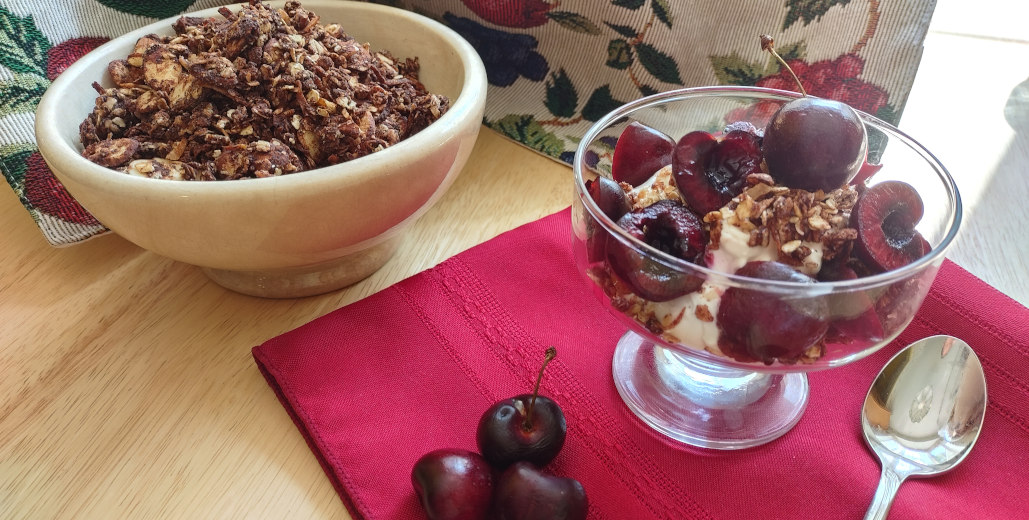
Chocolate for breakfast? Usually I’d be skeptical, but this granola packs a lot of protein, not too much sugar, and incredibly luscious flavor. Pair it with whole milk yogurt and some fresh cherries for a decadent yet healthy treat!
If your yogurt-and-granola routine is getting a little boring, try this twist on traditional granola recipes! Dark cocoa powder and ground cinnamon provide a welcome change of pace for this morning staple. Paired with oats, almonds, and coconut, the flavors really shine.
This isn’t one of those granola recipes that calls for 26 different ingredients and whatever fruit and nut combinations you happen to have on hand. Instead, the carefully matched flavors provide a nice balance of deep and rich cocoa with the classic almond + coconut combination.
Even better, you control the amount of sugar that goes into the mixture. If you’re like me and don’t prefer overly sweet breakfast foods, just decrease the honey or brown sugar a bit to get the level of sweetness you want.
This delightfully different granola makes a great gift, too!
Method
Preheat your oven to 325 degrees F. Set aside one or two large, rimmed baking sheets. (If you only have one, you will need to stir the granola very carefully as it cooks! Two pans just makes it easier.)
In a large mixing bowl, combine the oats, almonds, coconut, and brown sugar. The recipe calls for rolled oats, but you can use quick oats in a pinch. It won’t affect the flavor or consistency of the finished granola.
Making your own brown sugar
For the brown sugar, I like to make my own. I only make as much as I will use in a few weeks. That way, you never have to worry about it getting hard or lumpy.
To make your own brown sugar, pour a cup or two of white sugar, turbinado sugar, or dehydrated cane sugar into a medium size bowl. Drizzle a tablespoon or so of molasses over the sugar, then work it into the sugar with your hands. I’ve tried using a spoon, but that never seems to really mix it thoroughly.
When all the sugar is the same color (with no white patches in the bottom of the bowl), you’re done! Add a little more molasses if you like a darker brown sugar. I have used both blackstrap molasses and table syrup (also known as light molasses or treacle) to make brown sugar. I prefer a dark brown sugar, so blackstrap molasses is usually my first choice.
After you’ve made your brown sugar and combined it with the dry ingredients, get another medium-size bowl or large liquid measuring cup to mix the wet ingredients. Melt the coconut oil, either in the microwave or on the stovetop, over low heat. Add the cocoa powder, honey, cinnamon, and salt. It might seem odd to add these to the liquid rather than the dry ingredients, but this step does seem to help spread the flavors out evenly through the granola.
Once everything is combined thoroughly, spread the granola mixture out on your baking sheets. Try to spread it as evenly as possible, without a mound in the middle. Bake the chocolate granola for 45 minutes to an hour, checking it every 15 minutes.
When you check the granola, remove the pan from the oven and place it carefully on top of the stove or a heatproof surface. Stir through the mixture with a large wooden spoon, being careful not to spill any granola out of the pan. This is where splitting the mixture between two pans makes things easier! You want to stir from the outside of the pan in towards the center, because the edges will bake faster than the middle. Then spread granola from the center outwards, toward the edges.
This granola doesn’t get much darker in the oven, due to the already-dark color from the cocoa, so it can be hard to determine exactly when the granola is done. It’s best to watch the almonds and coconut carefully for a change in color. They start out white or nearly white, and they should turn light brown when the granola is finished. Smell is also a good indicator. When you start smelling toasted coconut and almonds, your granola is likely done!
Remember that the granola will continue to harden as it cools, so don’t worry if it seems a little soft when you take it out of the oven. The enticing aroma will likely draw everyone in the house, so good luck cooling it completely before everyone wants a taste!
This chocolate coconut granola may be stored in an airtight container at room temperature for several weeks, so don’t be afraid to double the recipe!
Chocolate for breakfast? This granola combines lots of protein and flavor with just the right amount of sweetness for a healthy yet decadent treat!
Prep Time10 minutesmins
Cook Time1 hourhr
Total Time1 hourhr10 minutesmins
Course: Breakfast
Cuisine: American
Keyword: Chocolate, Coconut, Granola
Servings: 6cups
Author: kimberly
Ingredients
3cupsrolled oats
1cupsliced almonds
3/4cupshredded coconutunsweetened
1/3cupdark brown sugar
1/2cupunsweetened cocoa powder
1/3cuphoney
1/3cupcoconut oilmelted
1-1/4tspcinnamon
1/2tspsalt
Instructions
Preheat your oven to 325 degrees Fahrenheit. In a large mixing bowl, combine the oats, almonds, coconut, and sugar.
In a separate bowl, mix the cocoa powder, honey, melted coconut oil, cinnamon, and salt. Combine the two mixtures and stir until the dry ingredients are thoroughly moistened.
Spread the granola mixture out on one or two large, flat baking sheets with raised edges. Bake the granola for 45-60 minutes, stirring every 15 minutes. The granola is done when it is dry and the almonds and coconut pieces are lightly browned.
Cool completely in the pan before transferring to a storage container. This granola will keep in an airtight container at room temperature for several weeks.
This sweet and fruity, slightly fizzy apricot iced tea will put you in a summery state of mind at first sip!
What captures the sun-drenched essence of summer better than ripe apricots? This sunny apricot iced tea will transport you to lazy afternoons on the front porch swing with the first sip! Sweet and fruity, with a bit of fizz just for fun, this is one recipe you will find yourself making again and again this summer.
Iced tea is perfect for hot days when you need a cool, refreshing drink. Make it with strong black tea for a garden tea party, or use decaf or herbal tea for a drink the kids will love.
Method
Just a few simple ingredients combine to make this one refreshing hot-weather beverage.
Make one quart of strong apricot-flavored black tea. I used 5 tea bags to one quart of boiling water. The tea I used was a Decaf Apricot Black Tea from The Republic of Tea. You can use regular black tea, but the flavor will not be as strong. If you desire a lighter, fruitier flavor, try an herbal blend instead of black tea: the Cinnamon Apricot Tisane from Monterey Bay Spice Company would work very well here.
Do make sure you brew your tea double-strength if using an herbal blend, or even with black tea if you want a strong tea flavor. The juice and seltzer water will dilute the tea to about half-strength. I was making this recipe with kids in mind, so I was happy with the less intense tea flavor.
Chill the tea for at least one hour in the refrigerator. You may add some sugar while the tea is still warm if you prefer.
Prepare the apricots: drain one 15-ounce can of apricot halves and reserve the juice. Mash the apricots with a fork or a potato masher, or in a food processor. Canned apricots are pretty soft, so if you don’t have a food processor, don’t worry!
Mash the canned apricots with a fork or a potato masher. Alternatively, puree in a food processor.
When the tea is chilled, pour it into a 2-quart (or larger) pitcher or jar. Add the mashed apricots, reserved apricot juice or syrup, and two 12-ounce cans of peach or apricot-flavored seltzer water. Apricot-flavored seltzer water can be hard to find depending on where you live, but peach works just fine.
Stir well and taste for sweetness. Depending on whether your apricots were canned in juice, light syrup, or heavy syrup, you will need to add more or less sugar. I used apricots that were canned in extra light syrup, and I added 6 tablespoons of sugar to the final mixture. If you aren’t sure how much sugar you will need, try adding just one or two tablespoons at a time; stir; and taste again for sweetness. That way, you won’t end up accidentally adding too much!
Add 2-3 cups of ice cubes and serve immediately. Be sure to stir or shake before pouring the tea, or the apricot bits will all fall to the bottom of the pitcher.
If you are making this tea ahead, don’t add the seltzer water or ice until just before serving. You can mix the tea, mashed apricots, and apricot juice in a pitcher (with some sugar if desired) and store in the refrigerator for a day or two before serving.
After adding the seltzer water and ice, the tea is best drunk the same day. You can store any leftovers in the refrigerator, but you will lose the bubbles!
Sun-drenched summery goodness in an icy glass… this iced tea will transport you to afternoons on the porch swing at the first sip!
Prep Time5 minutesmins
Chilling1 hourhr
Total Time1 hourhr5 minutesmins
Course: Drinks
Cuisine: American
Keyword: Apricot, Iced Tea
Servings: 2quarts
Author: kimberly
Ingredients
1quartstrong brewed apricot-flavored black tea
15ouncescanned apricots in juice or syrupundrained
2 12-oz.cansapricot or peach-flavored seltzer water
sugarto taste
2-3cupsice cubes
Instructions
Brew the apricot-flavored black tea double-strength and chill in the refrigerator at least one hour.
Drain the canned apricots and reserve juice. Mash the apricots in a small bowl with a fork or potato masher, or puree in a food processor.
In a 2-quart pitcher, combine the chilled tea, mashed apricots, apricot juice, and seltzer water. Stir well and taste for sweetness. Add sugar to taste, 1-2 tablespoons at a time.
Stir in 2-3 cups of ice cubes and serve immediately.
Virtue isn’t just for “holy people.” Here’s a homemaker’s guide to practicing virtue in everyday life.
We’ve probably all heard the adage, “Home is a school for virtue.” Usually, that is said with children in mind: home is where they learn the rudiments of virtue and moral values (known as good behavior at that age). However, children are not the only people who spend most of their time at home.
Homemakers have the task of creating homes for their families. Those who are mothers also have charge of instructing their offspring and setting an example of virtue. Every homemaker, regardless of whether or not she has young children at home, can learn something from the “school of virtue” that is the home. Indeed, there are several specific virtues that are particularly suited to a homemaker’s role, and which can be cultivated through the everyday duties of homemaking.
The Fruits of the Spirit
There are so many different virtues we could talk about when it comes to homemaking! Hospitality is a great one, for instance. Gratitude is another indispensable virtue for homemakers. Then there’s patience, kindness, humility, beneficence… Where to start? Let’s begin with the Fruits of the Spirit.
St. Paul describes the characteristics of a person who is filled with grace and living in accord with God’s will. These characteristics are known as the Fruits of the Spirit, and there are traditionally twelve: charity, joy, peace, patience, benignity, goodness, long-suffering, mildness, modesty, faith, continency, and chastity. Sometimes we come across a shorter list of eight: love, joy, peace, patience, kindness, goodness, gentleness, and faithfulness.
These features of holiness may be evident in any man or woman who is striving to follow God’s Will, but that doesn’t mean they just happen. Surely not! They might seem effortless for some people, but all virtues must be practiced, or they’re not virtues at all.
Charity
“Charity begins at home.” Mother Teresa knew well that virtues must begin in the most common, intimate sphere of life: home and family. This is the necessary foundation even for heroic virtues of bravery or sacrificial love. Those don’t just appear out of thin air in times of trial; they must be nurtured in the mundane tasks and small choices we make every day.
Homemakers can cultivate charity by embracing their role in the home and family. It is easy to tell the difference between someone who is not thrilled about being “stuck at home” with the cooking and cleaning and kids, and someone who pours her heart and soul into being a homemaker. Even if it wasn’t her first choice.
That point is especially important, because the choice to love our families is a decision that has to be made again and again, every single day (and sometimes many times in a single day!). That means there is always a new opportunity to begin again, to say “I’m sorry,” and try harder.
How can we grow in charity at home? “Love is patient… love is kind. It is not jealous or boastful. It does not insist on its own way. Love bears all things, believes all things, hopes all things, endures all things. Love never ends.” (CF 1 Cor 13). Our homes and families are the perfect place to practice this foundational virtue, because that is the place we tend to relax and let our guard down. We are familiar and comfortable with our family members; we know them, and they know us.
Because of this, family relationships can get strained very easily. Our brothers and sisters, parents and children can hurt us more easily than casual friends or coworkers can, simply because we have a more intimate relationship with them. Charity sets matters right again, when people get upset. Charity smooths an angry countenance, and clears away the gloom of self-centered grumpiness.
A homemaker who wants to practice charity can find myriads of opportunities in her daily life. She can infuse love into all of her tasks: intentionally washing the dishes and hanging the laundry out of love for the people who dirtied the dishes and stained the clothes. She can make every chore into a prayer, and strive to serve her family as the Blessed Mother served her husband and Son during those many quiet years at home.
Joy
Joy is not just a feeling, although it is usually portrayed that way. The virtue of joy is more like a holy cheerfulness than exuberant emotions. It takes “willpower”–a conscious decision to be cheerful, even when we don’t feel like it. Joy can and does become a habit in people who practice it regularly, and joy is a characteristic trait of many great saints.
This virtue is important for homemakers to cultivate because the wife and mother usually sets the tone for the entire household, even if she doesn’t realize it. Her attitude impacts the rest of her family, either positively or negatively. By choosing to be joyful, homemakers fill their homes with sunshine. If a simple smile bestowed on a stranger can go a long way toward brightening his day, then think what an impact practicing conscious cheerfulness every day can have on your family!
How exactly can a homemaker be more joyful? This might seem more mysterious to some people than others, depending upon temperament. I tend to be more melancholic, so this is one area I need to constantly watch over! But even for those of us who are not naturally sanguine, there are simple, practical ways to gradually become more joyful.
One little way is to accept the day’s weather with a grateful heart: whether it’s raining or shining, you can choose to cheerfully accept whatever the day brings instead of complaining that your plans were ruined. Another little way to practice joy is stopping to appreciate simple things: the way the sun shines in your window, the delicate fragrance of a flower or the freshness after rain, the delighted smile that lights up a child’s face.
As you can see from these examples, joy springs from gratitude. On days when you feel anything but joyful, sometimes the most helpful thing is to take a break from whatever you’re doing, stop thinking negative thoughts, and start counting your blessings. I don’t know of any more effective way to break a grumpy mood and start fresh with a smile–and most likely with tears in my eyes.
Peace
Like joy, peace is often thought to be something that just happens to you. But any mother can tell you that when you live with small children, peace is rarely spontaneous. You have to make it happen. Peace is not just an absence of strife; it is something positive, not negative. Peace is a state of rest, acceptance, and trust. It comes through surrender of one’s own will to the will of God.
Peaceful people accept everything, both good and bad, as ultimately coming from God and allowed by His Providence. They are not anxious and worried about many things, as they trust that “all things work together for good, for those who love God” (Romans 8:28).
This does not mean that peaceful people are passive all the time, or that they are lazy and don’t try to better themselves or improve their situations. By no means! Peace is an interior disposition, which can be practiced even when exterior circumstances are tumultuous and call for decisive action.
Practicing peace is like cleaning the windshield of your car: it clears away the clutter of worldly anxieties and cares so that you can see where you’re going. Just as it’s even more important to have a clean windshield when the weather is bad than when it is bright and sunny, so it is even more important to practice interior peace when life seems to be falling to pieces, than when everything is going swimmingly.
Homemakers can practice peace through daily prayer and meditation, submitting their cares, anxieties, and desires to God’s will. They can act with a peaceful spirit by speaking calmly instead of letting their voices escalate in moments of exasperation. If there is anything in your life that causes you anxiety, consider whether or not you can remove it or turn it off. Perhaps watching or listening to the news makes you stressed. Reading the newspaper or getting your news from one veritable source (as opposed to anything and everything in the media) might be a good alternative.
If social media eats away at your peace of mind, it is wise to limit the time you spend on those platforms–or leave them altogether. Whatever is true, noble, right, pure, lovely, or admirable, think on these things (CF Philippians 4:8). These are the things that will set your heart and mind at peace, when you are rocking on a turbulent sea of emotions and worries.
Kindness
Kindness is not a popular virtue at this point in time. Relativistic “tolerance” takes its place on the list of approved social virtues. But tolerance is very far from kindness. It says, “You can say or do anything you like, as long as you don’t try to impose restraints of any kind on anybody.” It is supposed to do away with judgment, but in reality, it harshly judges those who are supposedly “intolerant” of popular practices or beliefs.
Kindness, on the other hand, has nothing to do with judgment. It is simply reaching out to another person with love. Therese of Lisieux said that doing little things with great love is like an escalator to heaven. Why? Acts of kindness keep you focused on the other person and his needs, rather than what you think about his moral choices or social status. Kindness is a concrete way of putting charity into action. By practicing little acts of kindness regularly, you will start to focus less on yourself and more on others.
Many people strive to become less selfish as they seek to live a good and virtuous life. That is a very difficult thing to do! It seems that the harder you try, the more you see your own selfishness. St. Therese compared kindness to a spiritual escalator because it’s an unconscious dying to self: by practicing kindness, you’re not thinking about yourself at all. You don’t notice yourself becoming less selfish, but selfish habits melt away as you start to focus more and more on others.
One of the biggest excuses people have for lack of kindness is being “too busy.” We have all been unkind at one point or another: whether it was driving past a beggar on the corner because you didn’t want to be late for your meeting, failing to notice the cashier at the grocery store because you were too absorbed in what you needed to do next, or brushing your child away when he asked for a story because you were in the middle of some urgent task.
Finding the time to be kind needs to become a habit in order to really be effective. Some people keep a string of beads in their pocket as a reminder: whenever you do an act of kindness, slide one bead to the other end of the string. The point isn’t so much using up all of the kindness beads every day, as making kindness a habit.
As homemakers, so much of what we do every day seems small and insignificant. Yet, how often do we stop to think about incorporating kindness into our interactions with family members and others? Kindness doesn’t require great deeds. It can be as simple as taking a few extra minutes to pack your husband’s lunch before he heads to work, or stopping to compliment your neighbor on his flower beds. Even the smallest acts of kindness are precious in the eyes of our Maker.
Gentleness
In a world where women are told to be strong and assertive, a gentle wife and mother is a quiet reminder of what womanhood is designed to be. A gentle woman is strong in her own way, which is different from the strength of a man. “Strength and dignity are her clothing” speaks of the virtues of gentleness and modesty. According to the Biblical author, these virtues are a source of strength and dignity which are particular to women.
Both of them require a kind of reservation: their strength is like the strong walls of a castle, instead of the strength of an army going forth to battle. Both kinds of strength are admirable, but neither can stand alone. The army needs a strong place to retreat and regroup, while the castle needs an army to defend it. The different strengths of men and women are complementary: they support and complete each other.
When men and women recognize this and work together, the result is a relationship of beautiful harmony. If they don’t, relationships often become battlegrounds, where both parties strive after the masculine form of strength, and the feminine element is lost.
It is worth noting that a gentle man is not effeminate. On the contrary, it is the best and most masculine of men who can see the value of gentleness, and balance it with a more overt and active form of strength. Loving husbands and fathers can be extremely gentle and tender with their wives and children. Just so, women can possess a high degree of more “manly” strength only if they are rooted in virtuous femininity. Joan of Arc comes to mind, among other holy women. When women strive for masculine strength without gentleness, it often degenerates into aggressiveness and tyranny because the foundation of virtue is not present.
How can homemakers practice the virtue of gentleness? Gentle words calm discord among family members, where harsh words stir up strife. A gentle touch conveys love and respect, where rough handling would be cold and domineering. Gentle speech reflects a mind and heart which is centered on the higher things, while coarse language reflects base and uncharitable thoughts.
***
I think that’s enough for today. Let’s continue with the rest of the virtues next week, shall we? In the meantime, how do you practice these virtues through homemaking? Let me know in the comments!
The flavors of apple and cream cheese Danishes combined in an easy French toast bake give you delicious flavor with much less effort than pastry-making!
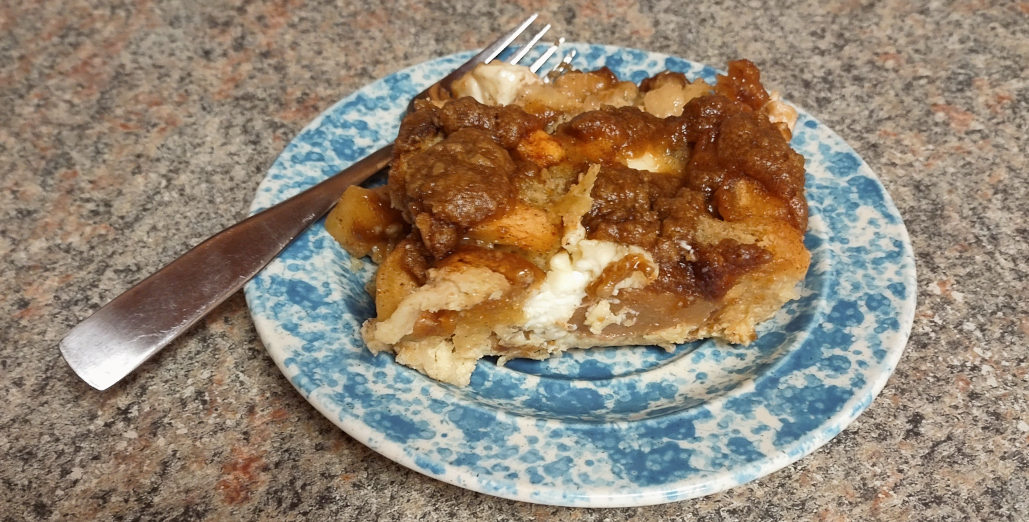
Fresh pastries are delightful, aren’t they? But they do take a fair amount of time and effort, so I don’t find myself making them often! However, the enticing flavors of apple and cream cheese Danishes can still be yours on busy mornings with this heavenly apple streusel French toast bake studded with nuggets of cream cheese!
The idea behind this recipe was twofold: first, I wanted a special dish that took thirty minutes or less in the morning, so I could bring it along to my mother’s house for brunch after church on Sunday mornings, without making hungry kids and husbands wait too long for their food. Second, I wanted something sweet but nutritious, tasty but not too decadent for breakfast.
The answer? A bread pudding (or French toast bake, if that’s what you like to call them) that bakes until not quite set in the evening, then gets popped back in the oven in the morning to add the finishing touches and crisp up the topping!
It relies on cinnamon and apples for natural sweetness, with a streusel topping for just the right amount of sugar on top. Cream cheese adds extra protein, while feeling decadent and making the dish look extra pretty.
Speaking of protein, bread puddings are definitely health foods, in my opinion! Start with homemade whole wheat bread, add eggs and milk to hold everything together, throw in some flavorful additions like cream cheese, fruit, and spices, and you have yourself a protein-packed breakfast!
Of course, the more sugar you add, the more it starts to taste like dessert… and you certainly could serve this as dessert, with a scoop of ice cream or a whisky cream sauce, perhaps. And for even more decadent Danish-inspired flavor, use day-old croissants instead of regular bread! That combination is pretty magical.
Whether you serve this bread pudding for breakfast or dessert, it will make a pretty addition to any special meal!
I modeled this apple French toast bake recipe loosely after my all-time favorite pumpkin cream cheese French toast bake from Dinner then Dessert. That one is definitely sweeter, but oh so delicious! It makes several appearances in my kitchen throughout September and October each year!
Method
First, preheat your oven to 350 degrees F. Butter the bottom and sides of a 13×9″ baking pan and set aside.
Prepare the apple filling: Peel and chop the apples. Melt butter in a skillet, then add the chopped apples and saute over medium-low heat for about ten minutes, until the apples are soft. Stir in the sugar and cinnamon.
For the bread pudding: Cube a loaf of bread (you will need about 10 cups) and set aside. Cubes that are 1-inch to 1-1/2 inch in diameter work well. In a large mixing bowl, combine the eggs, milk, cream, vanilla extract, sugar, and cinnamon. Beat lightly to combine. Add the bread cubes and stir well, making sure all the cubes are moistened. Set aside while you make the streusel topping.
Aim for a crumbly texture when making the streusel topping. Don’t mix too much!
For the streusel: Combine the flour, brown sugar, cinnamon, and nutmeg in a small bowl or food processor. Cut in the cold butter with a pastry blender, or pulse in food processor until the mixture is crumbly. Don’t process too long, or you will end up with a sticky paste!
Layer the apples and cream cheese chunks on top of the bread cubes in the pan.
To assemble the French toast bake: Layer half of the bread mixture, half of the apples, and half of the cream cheese chunks in the prepared pan. Repeat layers. Sprinkle the streusel topping over the apples and cream cheese.
Baking: Option 1
Bake the French toast bake for 40 minutes, until almost set. Remove from the oven and cool on a wire rack. Cover and chill overnight in the refrigerator.
In the morning, remove the pan from the refrigerator while you preheat the oven to 350 degrees F. Bake for 25 minutes, until the center is set and the topping is crisp.
Baking: Option 2
If you don’t need to chill the French toast bake overnight, go ahead and just bake it for a full 50-60 minutes, until the center is set and the topping is crisp.
Mmm, warm apples and cinnamon, paired with sweet streusel and cream cheese make one decadent brunch bake!
The flavors of apple and cream cheese Danishes in an easy breakfast casserole is simple to make, yet so satisfying! It's perfect for brunch or dessert.
Preheat the oven to 350 degrees F. Butter a 13×9" pan and set aside.
Saute the apples in 1 tablespoon of butter for about 10 minutes, until they are soft. Stir in 3/4 teaspoon cinnamon and 2 tablespoons sugar.
In a large mixing bowl, combine the eggs, milk, cream, vanilla, sugar, and 1/2 teaspoon cinnamon. Add the bread cubes and stir well to combine.
In a small bowl or food processor, combine the flour, brown sugar, cinnamon, and nutmeg. Cut in butter with a pastry blender or pulse in food processor until crumbly.
To assemble the French toast bake: layer 1/2 of the bread mixture in the buttered pan, followed by 1/2 of the apple filling and 1/2 of the cream cheese chunks. Repeat layers. Top with streusel.
Bake for 45 minutes. Remove from oven and let cool on a wire rack. Chill in refrigerator overnight. In the morning, remove the pan from the refrigerator while preheating the oven to 350 degrees. Bake for another 25 minutes, until heated through.
Notes
Alternatively, if you do not need to chill the French toast bake overnight, you can just bake it for 50-60 minutes, until the topping is crisp and the center is set.
Hi, I’m Kimberly! I’m an Alaskan wife and mother who loves simple, old-fashioned living. If you’re looking for country-style recipes from scratch or simple homemaking ideas, pour yourself a cup of tea and join me!










 Hi, I’m Kimberly! I’m an Alaskan wife and mother who loves simple, old-fashioned living. If you’re looking for country-style recipes from scratch or simple homemaking ideas, pour yourself a cup of tea and join me!