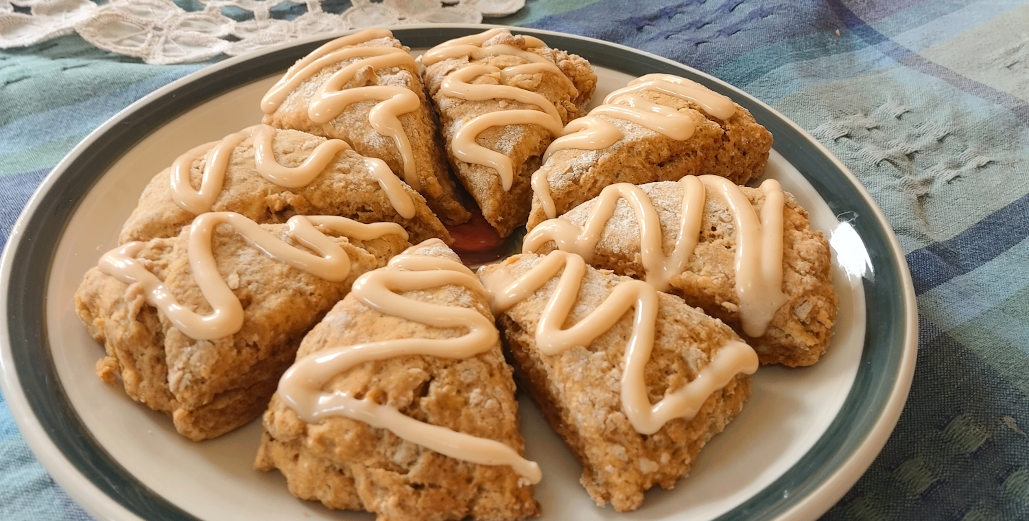
Tea and scones, anyone? You won’t have to ask twice, when the tantalizing aroma of these pumpkin spice scones wafts through the house!
Need a festive, fall-themed treat to add to your tea table or harvest gathering? These iced pumpkin scones perfectly complement the season of blustery weather and brilliant colors. Pair them with soup on a chilly day, or serve among other dainties for an autumn tea party. Whenever you bake these, don’t expect them to last long! The aroma of these scones fresh from the oven is enough to draw eager taste-testers!
I can’t recall where the original recipe for these scones came from, but I have been making this version for the past year. The sweetly spiced orange-hued scones with a drizzle of cream cheese glaze atop seems just the right combination of sweet and spice. I hope your family enjoys these iced pumpkin scones as much as mine does!
Method
Preheat your oven to 425 degrees F. Butter a large, rimmed baking sheet and set it aside.
Combine the dry ingredients in a large mixing bowl: add the flour, sugar, salt, baking powder, baking soda, and spices. Stir to combine.
You can use all-purpose flour or a lower-gluten whole wheat flour in this recipe. I have made these scones with a mixture of half all-purpose and half white whole wheat flour. You could also use whole wheat pastry flour, as this has a lower gluten content.
A word on gluten
Why is lower gluten important? Gluten is formed by two proteins in a grain when they are exposed to moisture. This compound makes a dough stronger and more elastic. Flours with a high gluten content make yeasted breads rise better, so it is good for using in those recipes. Bread flour, pizza flour, and hard red whole wheat flours have high gluten content, up to 13%. Sometimes bakers even add extra gluten to their flour with a dough enhancer, if they need a dough to be especially strong.
However, gluten can make delicate cakes, pastries, and quick breads tough in texture. I like my scones light and feathery, so I look for lower-gluten flours and use a gentle hand when kneading.
Cake flour has the lowest gluten content of any flour, at 7 to 8% gluten. It has been subjected to a harsh bleaching process which strips the grain of vitamins and minerals, as well as weakening the gluten. Pastry flour is another good option for light-textured baked goods, at 8 to 9% gluten. It is made from a different type of wheat than bread flours, usually a soft spring wheat. You can find pastry flour in white or whole wheat varieties.
All-purpose flour is a combination of different types of flour, so its gluten content ranges from 9 to 12% depending on the brand. The point of all-purpose flour is that it can be used for any type of baked good, from yeasted breads to pastries. However, if you want a nice high rise to your yeast breads or the lightest, flakiest pastry, then it might be better to use a different type of flour.
I like to use a mixture of unbleached all-purpose flour and whole wheat flour in my baking. For yeast breads and pancakes, I use whole wheat flour made from hard red wheat. For scones, muffins, and quick breads, I use white whole wheat flour, which has a gluten content similar to all-purpose flour. (King Arthur White Whole Wheat Flour has 12.2% gluten.) And for the lightest cakes, I use straight all-purpose flour. Cake flour has an unpleasant flavor due to bleaching, in my opinion.
If you would like to learn more about gluten, this article on the Gluten Content of Flours is helpful.
Back to the recipe…
When the butter and cream cheese are incorporated into the flour mixture, it should look crumbly.
Once your dry ingredients are combined, cut in the butter and cream cheese with a pastry blender or a fork. It works best when they are cold, so keep them in the refrigerator until you are ready to use them. I add the butter and cream cheese together, even though the textures are slightly different. The pieces are small enough when they are about the size of peas and the mixture looks crumbly.
In a smaller bowl, combine the pumpkin puree, eggs, and cream. Whisk lightly, then pour into the flour mixture. Stir until the mixture forms a soft dough. Add a little more cream if necessary.
Place the ball of dough onto a floured board. Knead it very gently a few times, then shape it into one large or two small flat discs. If you want to make large scones, shape the dough into one large disc about 3/4-inch to 1-inch high. If you wish to make smaller scones, divide the dough in half and shape each half into a disc about 1/2-inch high.
Pat the dough gently into one large or two small discs, then cut into wedges with a sharp knife.
Use a large, sharp knife to cut the dough into wedges: 8 wedges per disc makes a nice size. Arrange the scones on the prepared baking sheet so that the edges are not quite touching.
Bake the scones for 12-15 minutes, or until the edges are lightly browned. The larger scones may take a few more minutes to bake.
Make the glaze
Meanwhile, prepare the glaze. Combine the cream cheese, butter, and powdered sugar in a small bowl and mix well. Drizzle in cream or milk until the glaze reaches the desired consistency. If you are using regular cream cheese, add a few drops of vanilla extract or a pinch of cinnamon. Otherwise, pumpkin-spiced cream cheese spread makes a fun alternative! I have made it both ways, and both are delicious.
You can bake 8 large or 16 small scones on one large baking sheet. Separate the scones slightly before baking, so the edges are not quite touching.
Cool the scones on a wire rack for 10 minutes before glazing. Scones are best enjoyed the day they are baked, but you may store them, tightly covered, for 1-2 days if necessary.
Let these pumpkin scones bring the flavors of fall to your tea table! With their lovely orange hue and sweet spices, these scones will be requested again and again.
Preheat your oven to 425 degrees Fahrenheit. Butter a large rimmed baking sheet.
In a large mixing bowl, combine the flour, sugar, salt, baking soda, baking powder, and spices. Cut in the cream cheese and butter with a pastry blender or fork until the pieces of butter are the size of small peas.
In a small bowl, mix the pumpkin puree, eggs, and cream or milk. Stir the pumpkin mixture into the flour mixture until a soft dough forms. Remove the dough to a floured board and knead very gently a few times.
Shape the dough into a large, flat disc about 3/4 to 1 inch tall. Use a large, sharp knife to cut the disc into eight wedges. Transfer the wedges to the buttered sheet. Bake for 12-15 minutes, or until the edges are lightly browned.
For glaze, combine the cream cheese, butter, and powdered sugar. Add the vanilla, if using, and dribble in the cream a little at a time until the glaze reaches the desired consistency.
Notes
You may use regular cream cheese, neufchatel cheese, or pumpkin-spice flavored cream cheese in this recipe.Instead of making 8 large scones, you may form the dough into 2 discs and cut them into 16 smaller scones.
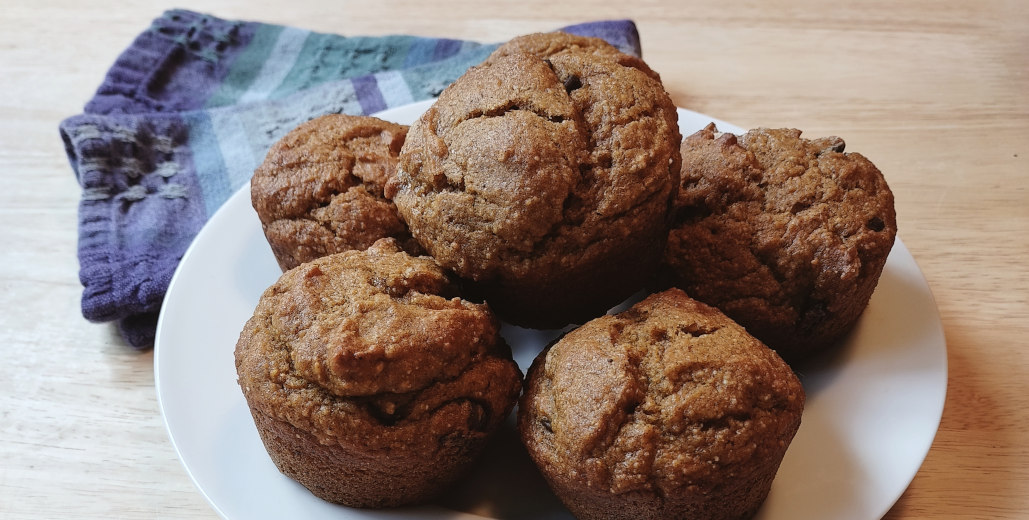
There’s a secret ingredient in these pumpkin chocolate chip muffins which makes them especially moist, and healthier too!
As soon as the weather turns cool and rainy, I start thinking about fall baking. I crave warm, comforting breads and baked goodies with plenty of spices and flavors of apples and pumpkin. These pumpkin chocolate chip muffins have been one of my go-to recipes for quite a few years. I can whip up a batch in about 5 minutes now, so you know I have made this recipe pretty often!
There are a couple of things which set this recipe apart from other pumpkin muffins. First, many pumpkin bread or muffin recipes call for quite a lot of vegetable oil. I don’t like to use heavily processed oils like that, so I usually substitute olive oil in recipes which call for vegetable oil. But nobody wants their pumpkin muffins to taste like olive oil! I solved that problem by using applesauce in place of the oil!
You do need some type of fat or oil, or the muffins won’t have the right texture. But I’ve found that a little bit of melted butter in addition to the applesauce works well. Thus, I get both apples and pumpkins in these muffins, though the apple flavor isn’t strong enough to taste.
Making a better muffin
Applesauce makes these muffins especially moist, without the residual greasiness you sometimes get with muffins that have lots of oil in them. So these pumpkin chocolate chip muffins are healthier and have a better texture! That’s a double win!
To increase the nutritional value of these muffins even further, use whole wheat flour for all or part of the flour this recipe calls for. I’ve written the recipe for using 1 cup of whole wheat flour and 2 cups of unbleached all-purpose flour, but you are welcome to use all whole wheat flour if you like. I recommend using a whole wheat pastry flour or white whole wheat flour in this recipe.
Method
Preheat your oven to 400 degrees F. Butter your muffin tins, or line them with paper cupcake liners. Set aside.
In a large mixing bowl, combine the applesauce, pumpkin puree, eggs, melted butter, and sugar. Stir well to combine. In another bowl, sift the flour with the salt, baking powder, cinnamon, ginger, nutmeg, and cloves. Stir the flour mixture gently into the pumpkin mixture. When it is almost combined, stir in the chocolate chips until no streaks of flour remain.
Fill the muffin cups 3/4 full with batter. (If you are using large bakery-size muffin tins, fill them about 2/3 full.) Bake for 18-20 minutes, until the top of a muffin springs back when touched lightly. Cool in pans for 2 minutes, then remove to a wire rack to cool completely.
When the muffins are cool, store tightly covered at room temperature for up to 3 days.
Enjoy!
Note: This recipe makes more or fewer muffins, depending on what size of muffin tins you use. For example, the last time I baked these, I made 18 standard-size muffins and 6 large bakery-size muffins, for a total of 24 muffins. If you use all standard-size muffin tins, expect to make 30 muffins. If you use all large-size muffin tins, expect to make about 15.
Applesauce makes these muffins especially moist, without any residual greasiness from oil. That makes these muffins both healthier and the perfect texture!
Prep Time10 minutesmins
Cook Time20 minutesmins
Total Time30 minutesmins
Course: Breads, Breakfast
Cuisine: American
Keyword: Apple, Chocolate, Muffins, Pumpkin
Servings: 30muffins
Author: kimberly
Ingredients
15ouncespumpkin puree
1cupapplesauceunsweetened
4eggs
1-1/4cupssugar
1/2cupbuttermelted
2cupsall-purpose flourunbleached
1cupwhole wheat flour
2tspbaking soda
2tspbaking powder
1tspsalt
1tspground cinnamon
1/2tspgrated nutmeg
1/2tspground cloves
1/2tspground ginger
1cupchocolate chips
Instructions
Preheat your oven to 400 degrees F. Prepare your muffin tins with butter or paper cupcake liners.
In a large mixing bowl, beat the pumpkin, applesauce, eggs, sugar, and melted butter until smooth.
In another bowl, sift the flour with the baking soda, baking powder, salt, and spices. Add to the pumpkin mixture and stir until nearly combined. Stir in chocolate chips until no streaks of flour remain.
Spoon the batter into the prepared muffin tins. Bake for 18-20 minutes, or until the top of a muffin springs back when touched lightly. Cool in pan for 2 minutes before removing to a wire rack to cool completely.
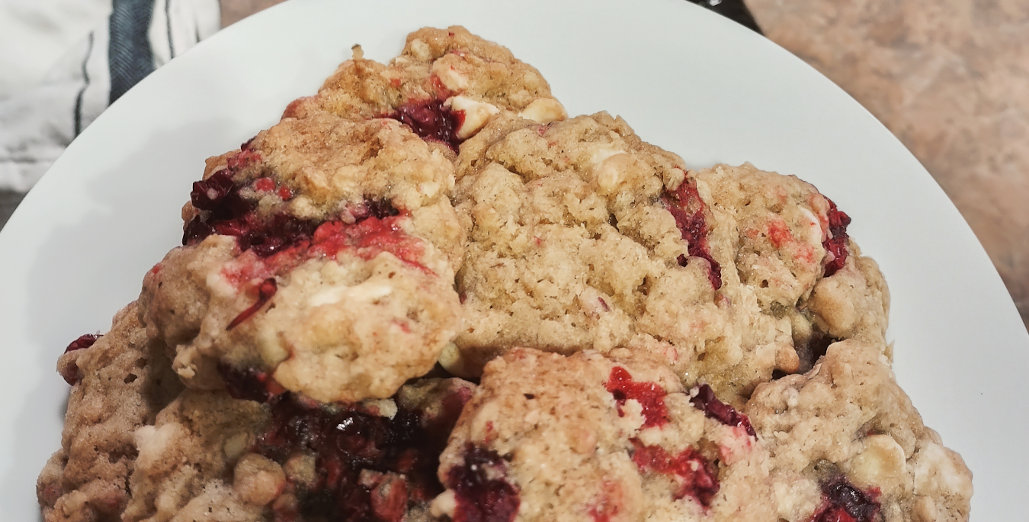
Fresh cranberries in a cookie? Yes indeed! There’s something about these cookies that makes them an instant family favorite. In fact, they have become legendary in my family, thanks to my sister Bethany who loves to bake them.
While they are quite simple to make, the white chocolate and tangy cranberries make an unforgettable combination that will have you baking them again and again. And don’t expect these cookies to sit around in your cookie tin–once your family gets a sniff, they will be gone as soon as they’re cool enough to touch! (My husband admitted to consuming five cookies in one sitting the last time I made them!)
Method
Preheat your oven to 350 degrees F. You will need to bake these cookies in several batches, so it is helpful to have at least two baking sheets. Lightly butter the sheets and set them aside. While these are buttery drop cookies, the fresh berries tend to stick to the pans, so that’s why I recommend buttering them. Alternatively, you may line the baking sheets with parchment paper.
In a large mixing bowl, cream together the butter and brown sugar. Brown sugar makes these cookies soft, and lends a subtle depth of flavor. You may find it easier to use an electric mixer to make the dough, but if your butter is soft enough, a wooden spoon works just fine.
Add the eggs and vanilla extract, and stir well to combine.
In a medium-size mixing bowl, sift together the flour, oats, baking soda, and salt. Add them to the creamed mixture, and mix thoroughly. Fold in the white chocolate chips and cranberries.
Using Fresh Berries in Cookie Dough
For this recipe, I use lingonberries, or lowbush cranberries, as they are commonly called in Alaska. This is a smaller cousin of the cranberry, which tastes very similar. (They are more intensely tart, if you ask me.) These berries grow wild in Alaska, Canada, the Pacific Northwest, and parts of Northern Europe.
Lingonberries are ideal to use in this recipe because they are small and firm. If you cannot get lingonberries where you live, you may substitute regular (fresh) cranberries. Since those are bigger and tend to be less juicy, you may wish to chop them coarsely before adding them to the cookie dough.
When folding berries into cookie dough, you must work quickly and gently, or the berries will burst. Then you will have pink-streaked cookies and flat, chewy berries instead of whole, juicy ones. I like to use frozen berries, so they don’t burst or squish as easily. If you have trouble incorporating the berries into the cookie dough, err on the side of less mixing. You can always press stray berries into the top and sides of each cookie after you form them on your baking sheet.
Baking the Cookies
Drop the dough by tablespoonfuls onto the buttered baking sheets, spacing them 2″ apart. Press any stray berries and white chocolate chips into the cookie dough. Bake for 8-10 minutes, until the edges of the cookies are lightly browned.
Let the baked cookies rest on the pans for 2 minutes, then remove them to a wire rack to cool completely. The cookies will be fragile at first, so letting them rest on the pans for a few minutes gives them a chance to firm up.
These cookies will keep in an airtight container at room temperature for up to a week. They also freeze well, and may be stored in the freezer for up to 3 months.
Tart cranberries and luscious white chocolate pair perfectly in these easy drop cookies. They make a pretty addition to holiday cookie trays, but they are delicious all year long!
Prep Time15 minutesmins
Cook Time20 minutesmins
Total Time35 minutesmins
Course: Dessert
Cuisine: American
Keyword: Christmas, Cookies, Cranberry, Oatmeal, White Chocolate
Servings: 50cookies
Author: kimberly
Ingredients
3/4cupbuttersoftened
1-1/2cupsbrown sugar
2eggs
1tspvanilla extract
1-3/4cupsflourunbleached
1-1/2cupsquick oats
1tspbaking soda
1/4tspsalt
1cupwhite chocolate chips
1cuplingonberries or cranberriesfresh or frozen
Instructions
Preheat oven to 350 degrees F. Lightly butter two baking sheets and set aside.
In a large mixing bowl, cream together the butter and brown sugar. Add the eggs and vanilla, and mix well.
In another bowl, sift together the flour, oats, baking soda, and salt. Stir into creamed mixture until thoroughly combined. Dough will be stiff.
Fold in white chocolate and cranberries. Do not overmix, or the berries will burst and turn the dough pink.
Drop cookies by tablespoon onto buttered sheets. Bake for 8-10 minutes, or until the edges are lightly browned. Cool on sheets for 2 minutes, then remove to a wire rack to cool completely.
How to cultivate twelve timeless virtues through a life devoted to home and family. Grow in grace through your everyday life as a wife and mother!
Are there virtues specific to homemaking? Perhaps not exclusively, but the vocation of homemaking provides opportunities to practice many, many virtues. This series explores how homemakers can cultivate the twelve Fruits of the Spirit in everyday life, through their ministry of home and family.
In the first part of this series, we covered charity, joy, peace, kindness, and gentleness. This time, let’s talk about the remaining Fruits of the Spirit. Some of them are words you might not be familiar with, as they’re not used or talked about much these days. But that’s all the more reason to learn about them, and how they can help us become better homemakers!
There are seven remaining virtues to make up the original twelve Fruits of the Spirit: patience, goodness, long-suffering, modesty, faith, continency, and chastity. Why twelve, when only eight are mentioned in some Scripture passages? The passage in the book of Revelation, or the Apocalypse, refers to the Fruits of the Spirit thus: “On both sides of the river was the tree bearing twelve fruits” (Revelation 22:2). Also, if there’s a choice between eight or twelve ways to grow in holiness, wouldn’t you rather hear about all of them?
So without further ado, let’s examine these remaining virtues.
Patience
Patience isn’t one of those lesser-known virtues I was talking about. Opportunities for patience abound in home life, perhaps more than in any other area of life. This doesn’t make it any easier for most of us, unfortunately!
There are a lot of repetitive tasks in a homemaker’s daily life and routine. Preparing three meals a day, for example; or all the housecleaning chores that must be done again and again and yet again if we want to keep our homes in some semblance of order. Not everyone likes cooking, and even the ones who do get bored of it at times. I enjoy cooking for the most part, but there are many days when I would rather do just about anything than cook another meal. (Probably more often than not, during the third trimester and postpartum periods!)
Likewise with cleaning–which I don’t happen to enjoy nearly so much as cooking. It takes a healthy dose of patience to watch dirty feet run across my freshly cleaned floors without shouting or scolding. It takes patience to tackle the mountain of dishes without complaining, when my back hurts and nobody liked the meal anyways, even though I spent hours on it.
Yes, patience is a fundamental virtue for homemakers. We all need to work at it, no matter how patient we are by nature. I remember thinking that I was a rather patient person, as far as personalities went–back before I had children! It’s funny how living with a family shows you your faults in glaring detail. But remember, this is a good thing. If you feel like a complete failure at patience because you’re always yelling at your kids or frustrated with your husband, that’s the first step towards becoming a more patient person. Just think how impatient and selfish we all would be if left to ourselves, without any families to show us where we need to grow.
Since patience is so necessary for homemakers, there are almost unlimited opportunities to practice it throughout the day. As with any virtue, it’s best to start with small things instead of challenging yourself with heroism right at the start. Practice biting your tongue when a family member whines or complains, or even accuses you of something. There are times when a response is necessary, but it never hurts to take a minute to gather your thoughts and calm your temper before replying.
Goodness
How exactly is goodness different from kindness? Or in the older language, beneficence versus benignity? In the Summa Theologiae, Thomas Aquinas defines beneficence as simply “doing good to someone” (Summa Theologiae, II-II:31.1) He regards it as an act of friendship, and therefore of charity. In another place, he differentiates beneficence from benignity by stating that beneficence is chiefly the “will to do good” to someone, whereas benignity is the actual carrying out of that willed kindness (Summa Theologiae, I-II:70.3) So, while there is probably some overlap between these virtues, goodness is the interior disposition and intention to do good to others, while kindness is goodness put into action.
How, then, do we practice goodness as homemakers? If goodness is chiefly an interior disposition, you might be confused as to how it’s also a virtue.
Remember how we said that the virtues of goodness and kindness fall under charity and friendship? Reflect, for a moment, on how you tend to view and think about your best friends. Do you carefully review every request that a friend makes, or do you usually agree to help right away? If you see your friend in trouble, do you wait and see if she asks for help, or do you jump into action immediately? We tend to look on our friends from a perspective of love and goodwill. We want what’s best for them, and we are eager to offer help when we can.
Now think about your attitude towards family members, neighbors, and others you meet in day-to-day life. Examine whether you are quick to offer help or comfort, or whether there is some interior reluctance keeping you from being as kind as you could be. You will probably find that there’s some room for growth in every relationship.
The key to growing in goodness is to look at every person with love and compassion. Oftentimes, we feel estranged from a person because they hold different beliefs, or come from a different background, or act differently than we do. This feeling of “strangeness” keeps us strangers at heart; but we are called to reach past those barriers–which might only exist in our minds–and to see that other person as a child of God.
Long-suffering
What is long-suffering, and why is it a fruit of the Spirit? Fruits are supposed to be positive things, yet suffering doesn’t sound very positive. Aquinas explains that “the fact of not being disturbed by painful things is something to delight in” (Summa Theologiae, I-II: 70.3). If you’re still skeptical, let’s explore this virtue further.
The Oxford Dictionary defines long-suffering as “having or showing patience in spite of troubles, especially those caused by other people.” Merriam-Webster offers a slightly different definition: “patiently enduring lasting offence or hardship.”
So long-suffering is a type of patience: heroic patience. Patience that lasts more than an hour or a day, but for weeks, months, or years. Patience that the world cannot fathom, such as we see in the lives of people like Chiara Badano. She was diagnosed with an incurable tumor at the age of 17, and went from an active, athletic lifestyle to a life confined to bed. She died two years later, in the year 1990; but during those two years, she lived with such serenity and joy that everyone who met her marveled at her patience and hope. How, they asked, could a teenager with no possibility of recovery be so happy? She faced certain, painful death, yet she prepared for it “as if for a wedding” (chiarabadano.org).
What does long-suffering mean for homemakers? Perhaps it means accepting our crosses-big and small-with joy, just like Chiara Badano. It means being so solidly rooted and centered on God that worldly difficulties and afflictions don’t phase us.
Long-suffering doesn’t stand on its own as a virtue; it depends on many others: patience, hope, fortitude, and faith. If we want to live lives of radical joy, however, it will take radical, long-suffering patience.
Modesty
Modesty is a touchy subject, even for those who strive to dress modestly. Everyone seems to have different standards of modesty, and some even have different standards for different categories of people! I’ve heard the argument that men should just exercise better self-control instead of expecting women to dress a certain way. Then there’s the argument that modesty is just whatever a society defines it to be by the current fashions. Some people say that modesty is an artificial social restriction, and it doesn’t apply in “natural” societies such as those tribes found in parts of New Zealand.
All of these views seem to regard modesty as some sort of line between decency and indecency, particularly regarding women’s clothing choices. But that’s not the only approach to modesty. Virtues are not merely the “middle ground” between two vices; Aristotle calls them the “golden mean” which transcends the entire plane of natural acts, and takes one to a supernatural level. If we look at modesty in this light, as something positive in itself rather than negative, we can see that modesty is about giving proper respect to our bodies.
Dr. Alice Von Hildebrand wrote: “If little girls were made aware of the great mystery confided to them, their purity would be guaranteed. The very reverence which they would have toward their own bodies would inevitably be perceived by the other sex. Men are talented at reading women’s body language, and they are not likely to risk being humiliated when a refusal is certain. Perceiving women’s modesty, they would take their cue and, in return, approach the female sex with reverence” (The Privilege of Being a Woman). *This is an affiliate link; for my full disclosure regarding affiliate promotions, please read my disclosure statement.
Dr. von Hildebrand speaks of veiling as a sign of respect, which is particularly associated with woman. In this, she echoes Gertrud von le Fort’s great tribute to womanhood, The Eternal Woman. (This is an affiliate link; for my full disclosure regarding affiliate promotions, please read my disclosure statement.)
Veiling a woman’s body is not primarily about preventing men from lusting after her; rather, it preserves the mystery of her womanhood. The mysteries of the transmission of life, the hidden growth during pregnancy, and the process of birth are all entrusted to woman. They are hidden within her body. Every woman shines with this capacity for motherhood. The mystery of maternity is not to be taken lightly, and that is where modesty comes in.
Modesty is reverence for the human person as expressed bodily, physically. For women, this involves veiling their bodies to a greater degree than is necessary for men. Why? Gertrud von le Fort explains that when this veil is lifted, and woman’s body exposed (other than within the marriage covenant), the mystery of woman is destroyed. She is no longer respected as a person, as the bearer of life. Her body is denigrated to merely an object for sexual gratification, to be used and discarded at will.
By keeping the veil intact, modesty shows that a woman respects herself and expects others to respect her as well. A modest woman knows her own dignity and worth. She is not ashamed of her body, trying to hide something she deems unattractive; rather, she is protecting a precious jewel that has been entrusted to her as part of her womanhood.
Faith
Faith as a virtue pertains both to our relationship with God and our relationships with other people. Regarding the former, faith means that we subject our minds, hearts, and entire selves to God, believing and trusting in His words and commands. If we think about faith as it regards our neighbor, the virtue means fidelity: standing alongside our friends and neighbors through thick and thin (Summa Theologiae, I-II: 70.3).
Homemakers’ very lives are based on faith and fidelity: the faithful commitment of husbands to support their wives and children makes homemaking possible. Without faithful husbands who support the missions of their wives in the home, women have to devote much precious time to working outside of the home. While this is sometimes a necessity even with a supportive husband, it certainly makes homemaking harder.
Wives and homemakers have myriad opportunities to be faithful to their husbands and families: faithful in fulfilling their duties around the house and raising children, faithful in actively nurturing their marriages and showing love to their spouses through big and little actions, faithful in caring for friends and neighbors, faithful in upholding truth and virtue by word and example, faithful in guarding their families from negative influences and immoral social pressures, faithful in entrusting every care and concern to the Lord, faithful in walking along the straight and narrow path and encouraging their families to do the same.
I think faith is one of the most important virtues for homemakers to cultivate, and there’s no better way to do so than by daily prayer. Pray when you’re anxious; pray when you’re at peace. Pause in the middle of washing the dishes or sweeping the floor to breathe a few words of thanksgiving, praise, or petition. Cast every care on the Lord, and remember to thank Him for everyday miracles and blessings. Pray without ceasing, and your home will become a place of sanctuary.
Continency and Chastity
What is the difference between these two virtues? Chastity has a much broader definition, because it surrenders the entirety of our sexual instincts, desires, and acts to God’s will. This virtue can be practiced in different ways, however, without losing any of its value. Some people are called to live chastely as virgins, refraining from any and every sexual act. Others are called to marriage, where they are faithful to their spouses in thought, word, and action; and each sexual act in such a marriage becomes an act of virtue, as it is done in obedience to God’s plan for marriage and loving respect for the other person.
Continency, or continence, is the abstaining from sexual acts. Unmarried people, whether they are committed to a life of virginity or not, are called to practice continency until or unless they are called to marriage. But they are not the only ones who practice continence. Married spouses who use Natural Family Planning as a responsible way of growing their families also practice continency, during periods where the wife is fertile but a pregnancy would be unwise or harmful. For some couples, this can be quite a large part of their married life, if health problems or severe financial difficulties impede them from growing their family.
As homemakers, we practice these virtues as becomes our current state in life: married or unmarried. In either case, chastity should imbue us with a profound reverence for the gift of life and the value of each and every human person. Chastity teaches us that other people, of the same or opposite sex, may not be used for our own selfish desires, but they must be respected as children of God. We must always respond to them on the level of persons, not objects.
Chaste virginity, in our world today, is scorned and abused, or even seen as harmful to a person’s development. The example of a woman who chooses to live a life of virginity-whether temporarily, until marriage, or permanently-is a shining light of virtue in the midst of a corrupt society. The significance of virginity also affects marriage profoundly: single people who choose to live chastely show by their lives that marriage is something to be respected. On the contrary, single people who do not live chastely signify thereby their lack of respect for marriage and sexuality.
For more on the profound meaning of virginity, and womanhood in general, I suggest Gertrud von le Fort’s The Eternal Woman. It is a beautiful testimony to authentic womanhood, and the mission of all women as virgins or mothers. (This is an affiliate link; for my full disclosure regarding affiliate promotions, please read my disclosure statement.)
Chaste marriage, while not abused as much as virginity in our society, is generally regarded as a fairytale that rarely happens in real life. Wives who live chaste married lives are no less witnesses to virtue than their virgin sisters. Wives who are faithful to their husbands in thought, word, and deed build up marriage and family life. They proclaim by their actions that the marriage covenant is something to be deeply respected, and they show by their lives that fidelity to a spouse confers peace and blessings on a family.
In sum, chastity and continence are both positive virtues. They are not limitations to be ashamed of, but lifestyle choices to celebrate and live joyfully. The world needs more witnesses of chastity, and homemakers have a wonderful opportunity to show how a chaste life can bring peace, happiness, and fulfillment to women in particular.
Conclusion
This article turned out rather longer than I imagined, and there is so much more that could be said about these virtues! Much more has been written on them, and by better pens than mine.
Now, I am a homemaker, not a theologian; so if you happen to disagree with my definitions, that’s fine. My hope is to encourage you to live out these virtues through your life and mission as a homemaker. Your life is a witness, no matter how hidden and insignificant you feel. The things you do for your family every day really matter! Perhaps you will never see the fruits of your efforts in this life, but we have been promised that no effort at holiness is wasted. Cultivating the Fruits of the Spirit through your life as a homemaker will bear fruit of eternal worth.
Hi, I’m Kimberly! I’m an Alaskan wife and mother who loves simple, old-fashioned living. If you’re looking for country-style recipes from scratch or simple homemaking ideas, pour yourself a cup of tea and join me!









 Hi, I’m Kimberly! I’m an Alaskan wife and mother who loves simple, old-fashioned living. If you’re looking for country-style recipes from scratch or simple homemaking ideas, pour yourself a cup of tea and join me!