Posted on Leave a comment

DIY Hand Soap for under $5 per Year

DIY hand soap
DIY hand soap

Are you trying to find ways to cut down on household expenses? Do you like the convenience of hand soap but not the price and waste of individual dispensers? Read on to learn how to make DIY hand soap that costs less than $5 per year!

Soap shouldn’t be an expensive item in your shopping cart. Sure, there are plenty of brands out there which offer exotic scents and pretty bottles to grab your attention (and your dollars).

But if you’re looking for a simple way to economize on household goods and save money, this smart and simple DIY hand soap tutorial is for you!

Disclosure: This page may contain affiliate links. If you click the links and make a purchase, I may receive a small commission at no additional cost to you. Read my full disclosure here.

Step 1: Buy your soap

Start with a bottle of foaming hand soap. It can be any brand; just try to find a bottle that seems sturdy, because you will be reusing it. The longer this first bottle lasts, the more you save!

Dollar General offers different brands of foaming hand soap for $1.95-$3.00 for the budget options. There aren’t any dollar stores where I live, so mine was a little more expensive. However, the bottles have been lasting closer to 2 years, so I don’t mind.

Next, find a big bottle of liquid hand soap labeled “refill”. These are larger bottles than the individual dispensers. They are not meant to sit next to your bathroom sink, but rather refill the smaller dispensers several times.

I use the SoftSoap brand, which is $2.95 for a 40 oz. bottle. You may be able to find store brands for slightly cheaper prices. I believe Dollar General brand is $2.50 for 40 oz.

Larger sizes can also be cost effective. You can find bigger jugs of hand soap refills on Amazon or at your local restaurant supply store.

WARNING:

Don’t assume anything will be less expensive just because it comes in bulk sizing. Check the unit price first! For liquid soap, this is the price per ounce. It should be listed on the price tag, in smaller numbers than the actual price.

As a point of reference, the Dollar General brand 40 oz. bottle costs $0.06 per ounce. If you find something cheaper at an online retailer, make sure you remember to add any shipping costs to your calculations.

Step 2: Learn how to refill the dispenser correctly

Here’s where the math comes in. Once you have used up all of the soap in the foaming hand soap dispenser, now you have to start measuring. Don’t worry; it’s easy!

Make sure you rinse out the soap dispenser if your soap refill is a very different scent than what was originally in the dispenser!

The general rule of thumb is to fill the dispenser 5/6 full with warm tap water, and the remaining 1/6 with liquid soap.

However, you’ll notice that the foaming soap dispensers have a larger pumping mechanism that takes up more space in the bottle than non foaming dispensers have.

To account for that extra headspace, I usually fill the bottle just short of 3/4 full with warm tap water.

My foaming soap dispenser is a 10 oz. bottle. Others may be smaller or larger. I fill the bottle with 8 oz. of warm water.

You don’t have to measure, but I would recommend doing it the first time. That way, you can mark your dispenser for future refills.

If pen or permanent marker won’t show up on your bottle, try sticking a small piece of tape on the bottle at the level of the water.

Oh, and please do use warm water. You are trying to dilute the soap evenly throughout the water, and it’s harder to do that with cold water.

Set the pump back in the bottle and mark the bottle just under the bottom edge of the pump. Or you can just eyeball it!

Remove the pump again and fill the bottle with liquid soap up to the line you just made (real or imaginary). For my 10 oz. bottle, this is 2 ounces of soap, or about 1/4 cup.

Now screw the pump back in place. If you filled the bottle a little too full, you may get some suds coming out the top. Ideally, you want a little bit of headspace above the liquid in the container.

Tilt the bottle back and forth gently to combine the soap and water. You don’t want to shake it vigorously, or you’ll just end up with a lot of bubbles and most of the soap sinking to the bottom of the dispenser.

A clear soap dispenser is handy here, because you can see the soap as you put it in the bottle. Then, when tilting it back and forth, you know it’s all combined when you can’t see ripples of soap anymore.

Of course, clear soap is more difficult to see, but it’s still easier than using a dark-colored dispenser.

The first foaming hand soap dispenser I used was tinted deep purple, and there was no way I could see through it to tell if the soap and water were combined well enough!

That’s why I’ve been using clear ones ever since that first bottle broke.

That’s really all there is to it! You will notice that it only takes a couple of tablespoons of hand soap to refill the dispenser. Your big refill bottle of hand soap will last a long time this way!

For us, this DIY hand soap lasts about a year. You may find that it lasts you longer or shorter, depending on your family size.

diy hand soap

Notes on DIY hand soap

Why do you add the water first, then the soap?

This is to prevent soap bubbles in the dispenser. If you put the soap in first, and then hold the bottle under the tap, the water pressure will just fill your bottle with bubbles, and won’t leave enough room for the water.

Why is there so little soap in the bottle? Does that even get your hands clean?

Foaming hand soap dispensers are designed to work this way. Instead of wetting your hands, then pumping soap onto them and lathering up, the foaming soap dispensers skip that first step.

They combine water with soap so you just need to pump the soap and lather your hands, then rinse them under the faucet. This actually saves water in the long run, because you won’t run the faucet as long.

It also saves soap. Have you ever caught your kids with a handful of liquid soap? I rest my case.

To answer the last part of the question, I would say that the most important factor in actually cleaning your hands when you wash them is lathering them.

It’s the action of rubbing the soap all over your hands and working up a lather which traps the dirt and bacteria. Then rinsing the soap off rinses the grime off with it.

Both kinds of soap can clean your hands. Foaming soap might make it slightly easier to achieve a good lather- especially if your tap water is really cold in the winter, like ours!

***

I’m experimenting with some other soap recipes using natural ingredients. If you’re looking for a foaming hand soap recipe that uses all natural ingredients, check out this post from Katie at Wellness Mama.

If you have any other questions, I would be happy to answer them!
Posted on 2 Comments

Advent Traditions: Christmas Cookies from Around the World

Advent traditions
Advent traditions

It’s Advent! This time of watchful, joyful waiting is my favorite season of all! The weeks leading up to Christmas are full of Advent traditions and preparations: there are gifts to make and wrap, decorations to put up around the house, and of course lots of food to prepare.

Many old European Christmas and Advent traditions involve foods that are made weeks (or months) in advance and aged. This is especially helpful for busy homemakers who never seem to have enough time to bake everything right before Christmas!

Spreading out the Christmas baking is something I have been working on for years. I started with making my fruitcake early, and since then I’ve gradually incorporated other customary foods into our own Advent traditions.

Last week I shared some of my favorite cookbooks, and this week I’m giving you a glimpse inside my Advent kitchen. From cookies to celebrate the special feasts that fall during Advent itself to Christmas treats that need time to age, here’s a run-down of my Advent baking.

Christmas cookies

Disclosure: This page contains affiliate links. If you click the links and make a purchase, I may receive a small commission at no extra cost to you. Read my full disclosure here.

First Sunday of Advent: Stir-up Sunday

The first Sunday of Advent used to be known as “Stir-up Sunday” in some cultures, due to the words used in the Collect (the opening prayer of the Mass): “Stir up thy might, we beg Thee, and come…” In the old calendar, this prayer was used on the last Sunday of the Church year, right before Advent. It is still used in the Anglican tradition on that day. The words from the old prayer are: “Stir up the wills of Thy faithful people, we beseech Thee, O Lord…”

One of the best known Advent traditions on this day is to stir up fruitcakes or Christmas puddings, to symbolize the fact that our hearts need to be “stirred up” to receive the Lord at Christmas and at His second coming.

Fruitcakes

light fruitcake recipe

There are two basic types of fruitcake: light and dark. I prefer dark, spicy fruitcakes, which are mostly fruit with a little cake to hold everything together! My sister makes light fruitcakes, which are more like fruit-studded poundcakes.

Recipes for both types of fruitcake can be found in A Continual Feast, by Evelyn Birge Vitz. Did I mention that this is my favorite holiday cookbook? My mother has made special recipes from this book for years, and I was delighted to find that my mother-in-law also uses it!

Or you can try this recipe for a spiced light fruitcake, which I adapted from the aforementioned cookbook.

December 6: St. Nicholas’ Day

St. Nicholas, or Sinter Klaas, or Santa Claus, is associated with Christmas in several cultures. In the Catholic tradition, the feast of St. Nicholas is celebrated on December 6, during Advent. St. Nicholas was a real person, before he became the embodiment of Christmas! He was a bishop of Myra (in what is now Turkey) in the 4th century.

Many tales and traditions surround his life. One of the best known stories involves him dropping a bag of coins down the chimney of a family too poor to provide a dowry for their daughter to marry. Perhaps this is why Santa Claus is said to come down chimneys with his sack of toys?

If you want to celebrate this day like the Dutch do, have your children put out their shoes the night before. If St. Nicholas comes in the night, good children receive coins or treats in their shoes, while naughty children receive straw. Foil-wrapped chocolate coins are a tradition in our house!

Speculaas

advent traditions speculaas
Speculaas cookies are a great way to kick off your Advent feast day celebrations! These sweet, spicy cookies are a traditional Dutch treat. They are cut to resemble St. Nicholas or windmills.

Speculaas are Dutch cookies for St. Nicholas’ Day. They are light spice cookies with lemon or orange rind added to the dough: similar to pfeffernusse, but milder and without nuts or chunks of dried fruits and peel. They are traditionally shaped like St. Nicholas himself, or like windmills. It’s really not as hard as it seems to cut out a simple St. Nicholas figure.

These are some of my favorite Christmas cookies. I make the dough on St. Nicholas’ day and bake a few for us to enjoy, then freeze the rest for Christmas. You can find recipes in many cookbooks or online. Of course, my favorite is in A Continual Feast.

December 8: Immaculate Conception

This is a newer feast, established in 1854, but its importance in the Catholic Church is recognized by observing it as a solemnity. That means it has the same rank as Sundays. When the holyday falls on a Sunday, it is celebrated on the following Monday instead, so that neither feast is skipped.

Moravian Spice Cookies

Christmas spice cookies

Since it is more recently established, there aren’t many traditional foods associated with this day. Moravian Spice cookies can be made on this feast or the vigil, because of the Scripture passage Sirach 24: 20-21, “I gave a sweet smell like cinnamon and aromatic balm…” The passage describes Mary, but it mentions the spices in these cookies!

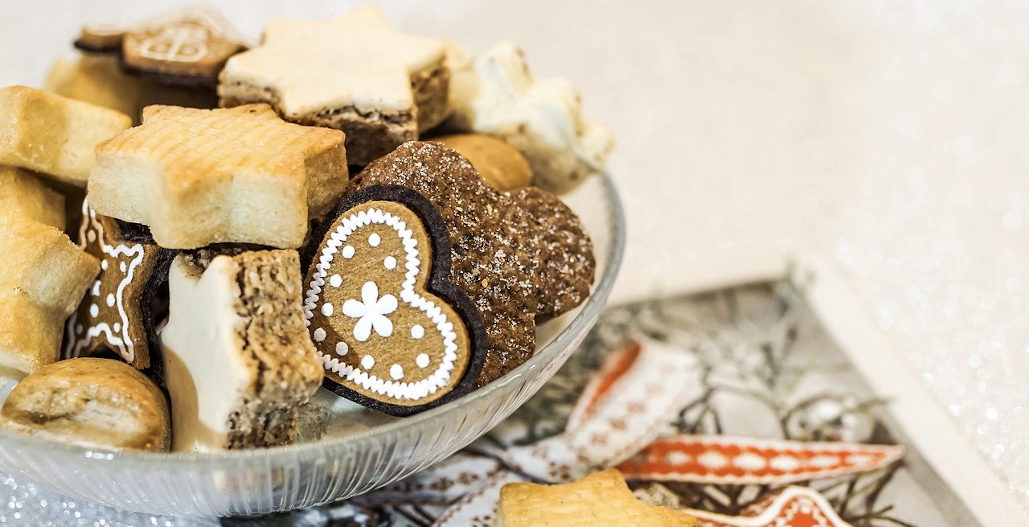
The dough is similar to gingerbread. It is rolled out very thin and cut into heart shapes. Once they are baked, the cookies are iced with fancy designs or religious symbols. You can find a recipe on Catholic Culture.

December 12: Our Lady of Guadalupe

This feast commemorates the apparitions of the Blessed Mother to an Aztec peasant named Juan Diego in Mexico in the year 1531. St. Juan Diego has his own feast day on December 9, but I’m not usually organized enough to celebrate both days!

Mexican Cookies

Advent traditions cookies
Polverones de canele are Mexican cookies rolled in a cinnamon-sugar mixture, similar to snickerdoodles.

Mexican food would be appropriate to make on one or both of these feast days. In keeping with the cookie theme, I like to make Mexican Wedding Cakes. These are little round sugar cookies made with ground or chopped almonds and covered in powdered sugar. I’ve also heard them called Russian Tea Balls.

Whichever the actual origin, they are quite tasty, and freeze very well. If you want an authentic Mexican treat, try polverones de canele, a cinnamon-sugar covered cookie similar to snickerdoodles.

December 13: St. Lucy’s Day

St. Lucy was an early martyr from Syracuse, Sicily. Like St. Nicholas, there are more legends than known facts about her. She has been revered as a saint for centuries, perhaps nowhere so well as in Sweden. The name “Lucy” means “light,” and she is known as the saint of light. The traditions for her feast reflect this.

St. Lucy’s Crown

In the Swedish St. Lucia celebration, the eldest daughter of the family is dressed in a white gown and red sash, and crowned with a wreath of greenery and lingonberry sprigs and lighted candles. She gets up before sunrise and goes about waking her family with special buns and coffee.

The buns (lussebullar) are made in an S shape or an X shape with the ends curled, an ancient symbol of the sun. Alternatively, a yeast cake shaped like a crown may be served. You can put lighted candles on the cake if you don’t desire a walking fire hazard! The buns and cake are traditionally made of sweet yeast dough flavored with saffron. There’s a great recipe in-you guessed it!-A Continual Feast.

St. Lucy Gingersnaps

Gingerbread cookies
Gingersnaps, or gingerbread cutout cookies, are traditional on St. Lucy’s Day.

Luciapepperkakor is another Swedish tradition on this day. You can find an authentic recipe, but I just make my favorite gingerbread cutouts. Eat a few tonight, and save the rest for Christmas!

Third Sunday of Advent: Gaudete Sunday

Somewhere in between all these feasts is the third Sunday of Advent, known as Gaudete Sunday. The word “Gaudete” means “rejoice” in Latin. It is the first word of the Introit for that day.

In past centuries, when Advent was observed as a more penitential season (like Lent), Gaudete Sunday was a day of reprieve from the fasting and penances. It is still a day of rejoicing, reminding us that our Advent traditions and preparations are making our hearts ready to receive our Savior.

The liturgical color for this day is rose, instead of penitential purple which is worn during the rest of Advent. This color is used for the priest’s vestments, the laudian or altarcloths, and the candle for the third week of Advent.

The overall theme of the day is one of rejoicing. Today marks the midway point in Advent. The theme of the daily readings switches from anticipating the end of the world to anticipating Christ’s birth. In a Judeo-Christian society, this is when Christmas preparations begin in earnest.

Pink Party

Pink Party
Why not make a pink party part of your Gaudete Sunday celebration? If you’re making cutout cookies, sprinkle crushed peppermint over them while the frosting is still sticky.

Thus, a party is appropriate to add to your Advent traditions. And a party means… cookies! Pink cookies! I’ve heard of baking sugar cookie cutouts today and frosting some of them pink. Otherwise, candy cane cookies or pink spritz cookies work well.

But don’t stop there. Why not carry the pink theme throughout your dinner to really make it special?

Rose wine or a Pink Lady cocktail for the adults, and cranberry punch for kids make fun pink drinks. Serve them in wine glasses to add to the festivity (if your kids are old enough).

Ham and cheese rollups, secured with a toothpick, are pink and have the added bonus of looking a little like roses (if you squint). Other ham dishes will also work. Pink fruits like berries, pomegranates, and grapefruit combine nicely in a fruit salad.

Last but not least, set some fresh flowers on the table. Pink roses put the crowning touch on your celebration!

December 21: St. Peter Canisius

Peter Canisius was born in Holland in the year 1521. He entered the Jesuit order and traveled all over central Europe, preaching, founding colleges, and advocating reform within the Church. He had tremendous influence in both religious and secular society.

Pfeffernusse and Springerle

Springerle traditions
Springerle molds can be quite intricate, depicting religious or secular scenes and motifs.

St. Peter Canisius spent much of his life in Germany, and he is one of the patron saints of that country. Therefore, I find it quite reasonable to make German Christmas cookies on his feast day.

Pfeffernusse, or peppernuts, are small, round, spicy cookies full of chopped almonds and citrus peel, and dusted with confectioner’s sugar. Grind your own spices for real old-world flavor! I have used different recipes, and am still experimenting to find one I like best.

Springerle are pale anise-flavored cookies. They are made with a specific springerle mold. You can find these in antique stores or specialty shops. Some look like rolling pins with different motifs engraved on them.

There are also lots of different recipes for these cookies. Some have whole anise seeds while others use powdered anise or anise extract. Plan ahead when making these cookies, because they need to sit out overnight on baking sheets.

December 23: St. John of Kanty

St. John of Kanty, or St. John Cantius, as he is sometimes called, was a Polish priest born in Kanty (Cracow, Poland) in 1397. He is known for teaching at the University and having a great love for the poor.

In honor of this saint, why not dish up some Polish food today? Kielbasi and saurkraut, pierogies, or cabbage rolls would be nice. It’s close to Christmas by now, so simple cooking now highlights the feasting that will begin in a few days. Simple meals are an important part of Advent traditions in many cultures.

Kolaczki

If you still want to make more cookies, try Polish kolaczki or kolachky. These jam-filled envelopes make pretty gifts–if you have any left after your family tastes them!

advent traditions cookie recipes

***

Well, that’s my Advent cookie-baking countdown to Christmas! By the time Christmas Eve rolls around, I can focus on other baking because all my cookies are done.

If you make all of these cookies along with me, you will have 8 varieties: Speculaas, Moravian Spice Cookies, Mexican Wedding Cakes or polverones de canele, Gingerbread, Spritz or cutout cookies, Pfeffernusse, Springerle, and Kolaczki. And fruitcake! Don’t forget about those fruitcakes wrapped tightly in the back of your fridge. (I did one year.)

I hope you find inspiration to start some new Advent traditions with your family. Happy baking!

Additional Resources

The Catholic All Year Compendium, by Kendra Tierney, is full of inspiration for celebrating the feasts and liturgical seasons as a family. Her suggestions fit kids of all ages, and most are simple enough for even the busiest of families.

Drinking with Saint Nick: Christmas Cocktails for Sinners and Saints, by Michael P. Foley, contains cocktail recipes and beer or wine suggestions for every day of the Advent and Christmas seasons! It’s a great way to learn about some lesser-known saints. Plus, it gives you so many ways to celebrate!

Posted on 2 Comments

9 Books for the Traditional Cooking Enthusiast

traditional cooking books
traditional cookbooks
traditional cooking books

Do you know someone who loves experimenting with traditional recipes and old-fashioned cooking methods? Perhaps you would like to be able to cook like your great grandmother did, but don’t know where to start. This list of cookbooks has something for every old-fashioned cook, whether you’re just starting out or you’ve been cooking for decades!

In compiling this list, my goal was to stay from cookbooks that are specific to one culture. However, this proved a daunting task. You see, the older the cookbook, the more specific its recipes are to the time and place it was written.

Also, if I included everything from Moroccan to French to Vietnamese cuisine, such a list would hardly be helpful- it would be way too long!

In the end, I just stuck with my favorite traditional cookbooks, which tend to be American or British in origin. I am listing them by difficulty level and familiarity of the recipes.

So the first few cookbooks are good choices for a beginning cook or one who is new to traditional cooking, while the end of the list is for nerds like me!

Disclosure: This page contains affiliate links. If you make a purchase through these links, I may receive a small commission at no extra cost to you. Read my full disclosure here.

Introduction to Traditional Cooking

These first three books are a great introduction to cooking from scratch if you aren’t very familiar with cooking but would like to learn. They contain classic recipes which call for common ingredients, for the most part.

While they are great for beginning cooks, I still enjoy these cookbooks because the recipes are for country meals I will make again and again.

1. The Prairie Homestead Cookbook

I think of this book as a helpful guide to American country cooking for the novice cook. Jill writes in a friendly, encouraging style and includes snippets of her life as a modern homesteader.

She explains her recipes step by step, and talks about what ingredients to use (that you can find in a normal grocery store)! Plus, the photos are gorgeous! It’s a delightful read even for seasoned cooks, and the recipes are tried and true favorites that the whole family will enjoy.

2. The Fannie Farmer Cookbook

This is the classic American cookbook. First published in 1896 by the Boston Cooking School, it contains recipes ranging from familiar (chicken soup) to unexpected (how to prepare a calf’s head).

More than a collection of recipes, it includes full menus and an assortment of household tips. This book uses standard measurements- in fact, it’s the book that standardized American cooking measurements!

I enjoy the soup recipes, as well as all the different ways to serve eggs!

3. An Unexpected Cookbook: The Unofficial Book of Hobbit Cookery

Yes, this cookbook is named after J.R.R. Tolkien’s classic. But it’s not a collection of outlandish movie-themed recipes. Instead, it is based on Tolkien’s inspiration for The Shire: the English countryside where he grew up.

This book is full of dishes from Victorian England, particularly ones the middle and lower classes would have eaten. The book is written in an easy-to-read style and includes vegetarian and vegan variations. It’s basically Victorian country cooking adapted for the modern kitchen.

One of my favorite recipes from this book is for a huge braided loaf of bread stuffed with mushrooms, cheese, onions, and herbs. Delicious!

Teaching Techniques

The next three books are specifically about teaching traditional cooking skills to the modern cook. They don’t look like normal cookbooks because the focus is on the skills. However, they do include a lot of great recipes!

4. Traditional Cooking School

The Traditional Cooking School offers several different books and courses on sourdough, cultured dairy, lacto-fermentation, cooking with einkorn, and more! The only one I have read to date is Sourdough A to Z, and I can vouch for its flexibility and thorough coverage of the subject.

One thing I enjoyed about this book is the different scenarios it offers for living with sourdough: whether you use your starter all the time and keep it active, or you’re like me and pull it out of the refrigerator once a week or so, the authors show you how to get the most out of your sourdough.

This book covers the history of sourdough, how it’s different from commercial yeast, how to make your own starter, and a huge selection of sourdough recipes. They show several different methods of bread baking, which I appreciate, because some of them worked better for me than others!

5. The Lost Art of Real Cooking

This is one of my personal favorites! It explores many different methods of traditional food preparation, from pickling and fermentation to bread baking and cooking meats and fish.

It explains not only the methods but also a good chunk of history. If you like learning the origins of different dishes, this is the book for you!

One thing I really appreciate about this book is its no-nonsense approach. The authors plainly state that their recipes are harder and take longer than what you would find in a “quick and easy” cookbook. But the end result is worth it!

If you’re intimidated by the idea of making your own tortillas or pickles, this book might be just what you need to get started.

6. The Lost Arts of Hearth and Home

A sequel to the volume above, this book dives into some more complex cooking skills like cheese making and brewing beer or kombucha. The authors do a great job of breaking down each project into simple steps.

As the title suggests, it’s not just about cooking. The authors explain how to build an outdoor oven, how to braid rugs, and how to make your own sewing patterns, among other things.

If you already know basic cooking skills and want to experiment with making more things at home, this is a handy reference. It’s a DIY guidebook for adventurous souls!

traditional cooking

European Traditions

As promised, this last section is for the traditional cooking enthusiast! If you’ve ever wanted to create a medieval feast or wondered what the traditions are behind special holiday foods, these are some books for you!

7. A Continual Feast

This is my go-to cookbook for holiday menus. It is structured around the seasons and feasts of the Christian year. Sections on celebratory feasts like Christmas include traditions from around the world, along with morsels of their history.

I love learning about different customs that celebrate the same feast days I do! There are some pretty old recipes here, from roast goose to lenten monastery soups.

If you want to celebrate like a medieval king or dine like a common serf, check out this treasure of historical meals!

You can read more about some of the Christmas recipes from this book in this article about Christmas cookies from around the world. Also, here’s one of my fruitcake recipes, which is adapted from this cookbook!

8. The Old World Kitchen

This book is a varied collection of recipes from 25 different European countries. It focuses on peasant fare, so you won’t find kingly menus in this book. However, the recipes are surprisingly exotic- and some are quite old.

The author’s goal is to provide authentic recipes that capture the spirit of peasant cooking and show what has been lost by mass production and over-refinement of modern foods.

To give you an idea of this book’s scope, the section on milk and dairy products includes recipes from Germany, Bulgaria, Finland, Iceland, Holland, France, Austria, England, Scotland, and Hungary!

In addition to recipes, she includes folklore and history about the different dishes. This is a fascinating and colorful read! I wish I could just sit down and read through it like a novel, but I’ve not found the time to do so just yet.

9. To The King’s Taste

This cookbook is a novelty collection of historic English dishes from the time of King Henry II. It has recipes you would expect, like traditional techniques for preparing game and the medieval combination of fish with fruits and spices, but there are also some surprises.

Did you know that the recent trend of roasted garlic is anything but new? Apparently, people discovered that delightful dish centuries ago.

The recipes have been adapted for the modern kitchen, so you won’t need to translate Old English to enjoy them!

Well, that’s my list of recommendations for the seasoned cook or someone just starting out. The skills of traditional cooking are becoming rarer as more people buy prepackaged foods. These books are a great starting point in regaining these important skills.

Do you have a favorite traditional cookbook? I would love to read it! Leave a comment below!

Posted on 1 Comment

Cranberry Scones

cranberry scones
cranberry scones
Here’s a cranberry scone recipe bursting with ripe berry flavor and hints of orange and spice.
Jump to Recipe

It’s beginning to look a lot like… winter in Alaska. Which does look like Christmas, at least for the first few months. Maybe that’s why my oven keeps producing festive baked goods like these cranberry scones with a hint of orange.

All the snow may be pretty, but it doesn’t always feel like a glorious winter wonderland.

How do you motivate yourself on a cold, dark winter morning when the door is frozen shut, the rest of the family is sick, and all you really want to do is curl up with a mug of tea and a good book?

In my case, you snuggle up with a mug of tea and a hungry baby, and after he’s fed, don an apron and start heating the oven! There’s nothing like baking to raise my spirits and get my day off to a good start.

cranberry scones plate
cranberry scones

Bright Berries

The bright red cranberries in these scones make them a particularly cheering, festive treat. Set a plate of these pretty scones on the table, and even an ordinary meal looks special! Or put the kettle on and invite a friend over for a cozy autumn tea.

The dominant flavor in these scones is cranberry, with subtle spices and bright orange zest for contrast. The texture is about midway between feathery English scones and dense, sweet versions. They are best fresh from the oven with a bit of whipped butter or clotted cream.

Cranberries are tart, so this recipe includes just enough sugar to balance out the tartness without making the scones taste especially sweet. (I don’t prefer sweet scones, because the sugar makes them dense and heavy.) Feel free to vary the amount of sugar or even drizzle a vanilla-flavored glaze on top if you’re looking for a sweeter scone.

Looking for something a bit lighter and sweeter? Try Cranberry Almond Scones for a different flavor!

Other cranberry scone recipes I’ve tried taste mostly of scone and a little of cranberry. These ones taste mostly of cranberry, due to the amount of fruit in the dough. You can always decrease the amount of berries if you want the orange flavor to come out more.

You don’t have to wait until winter to make cranberry scones if you freeze cranberries when they are in season. I always try to buy extra after Christmas, so I will have some on hand for the next few months, at least.

To use frozen cranberries in this recipe, you will want to let them thaw partially so you don’t break your food processor. The easiest way to chop them is with a food processor, but you can also chop them by hand. It just takes longer, and doesn’t work as well for frozen berries.

Festive Cranberry Scones

Method

Preheat your oven to 425 degrees F and butter a baking sheet. One large baking sheet will do whether you are making small or large scones.

Combine the flour, baking powder, salt, cinnamon, and sugar in a large bowl. Add more cinnamon if you want a stronger flavor.

Cut the butter into smaller chunks. I usually slice a stick of butter five or six times crosswise, and then once lengthwise. Add the butter to the flour mixture.

Use a pastry blender or a fork to cut the butter into the dry ingredients. The butter should be in pea-sized pieces when you’re done. The chunks probably won’t all be the same size; don’t worry! As long as they are roughly pea-sized, it will be fine.

Combine the milk and egg and beat lightly with a fork. Pour the milk mixture into the flour mixture and stir to combine. You don’t want to mix the dough too much once you add the liquid, or the scones will be heavy.

Sometimes I leave a few streaks of flour in the dough at this point, knowing that I’ll be mixing it more when I add the cranberries in a few minutes.

Chop the cranberries roughly. You can do this by hand or with a food processor. They do not need to be in tiny pieces. Once when I was chopping them by hand, I just cut them each in half and called it good.

Zest an orange and reserve one tablespoon of the peel. I always use fresh orange zest (or clementine, which is a bit milder), but you can use dried orange peel if you prefer. I would cut the quantity down to 1 or 1 1/2 teaspoons if you use dried peel.

Fold in the chopped cranberries and orange peel. Mix gently to incorporate. Again, you don’t want to overmix the dough.

Turn the dough out onto a floured board or countertop. Knead it gently 6 times. How do you knead gently? Just pat it out about 1 1/2-2 inches thick, then fold in half. Turn the dough a quarter turn in front of you. Repeat this five more times.

If you’re having trouble treating the dough gently, try patting out the dough with the flat palm of your hand, instead of the heel of your hand, which has more force. Flour your hands if necessary, but you’re not trying to work more flour into the dough.

When the dough is kneaded, pat it out into one large circle or two smaller circles, depending on whether you want big or little scones. Big is coffee shop size! Small is probably a more normal size. In either case, the dough should be about 3/4-inch to 1-inch thick.

Slice the circles into wedges: 8 for the large circle, or 6 for each of the smaller circles. Transfer to a buttered baking sheet. Keep the scones in circle formation, but separate them a little so that the edges aren’t touching. If they are too close together, they will rise and stick to each other- and take longer to bake.

Sprinkle sugar on the tops of the scones before baking, if desired. A little bit of sugar on top is nice with the cranberries. Pop them in the oven for about 20-25 minutes. If you made your scones thicker, it might take longer.

The cranberry scones are done when the edges start to turn brown and the bottoms are golden. Cool on a rack and enjoy!

Cranberry Scones

Here's a festive scone recipe bursting with ripe cranberry flavor and hints of orange and spice. Not too sweet or tart, but just right with a cup of tea.
Prep Time20 minutes
Cook Time20 minutes
Total Time40 minutes
Course: Breakfast, Side Dish
Keyword: Bread, Cranberry, Quick bread, Scones
Servings: 8 large scones or 12 smaller scones

Ingredients

  • 2 1/2 cups all-purpose flour unbleached
  • 2 tsp baking powder
  • 3/4 tsp salt
  • 1/2 tsp cinnamon
  • 1/4 cup sugar
  • 1/2 cup cold butter cut into chunks
  • 1 egg slightly beaten
  • 3/4 cup milk
  • 1 tbsp orange zest
  • 1 cup cranberries coarsely chopped
  • extra sugar for dusting

Instructions

  • Preheat the oven to 425 degrees F.
  • In a large bowl, combine flour, baking powder, salt, cinnamon, and sugar.
  • Cut in butter with a pastry blender or fork until the butter is in pea-sized pieces.
  • Add egg and milk and mix just until blended.
  • Fold in cranberries and orange zest. Mix gently.
  • Turn dough out onto a floured board. Knead gently 6 times.
  • Pat out 3/4-inch thick, into one large circle or two smaller circles. Slice into wedges: 8 for the large circle or 6 for each of the smaller circles.
  • Transfer to a buttered baking sheet and sprinkle extra sugar over the tops, if desired.
  • Bake at 425 degrees F for about 20-25 minutes, until the edges begin to turn golden. Cool on a rack.