Posted on 4 Comments

Tending the Fruits of the Spirit through Homemaking: Part II

How to cultivate twelve timeless virtues through a life devoted to home and family
How to cultivate twelve timeless virtues through a life devoted to home and family. Grow in grace through your everyday life as a wife and mother!

Are there virtues specific to homemaking? Perhaps not exclusively, but the vocation of homemaking provides opportunities to practice many, many virtues. This series explores how homemakers can cultivate the twelve Fruits of the Spirit in everyday life, through their ministry of home and family.

In the first part of this series, we covered charity, joy, peace, kindness, and gentleness. This time, let’s talk about the remaining Fruits of the Spirit. Some of them are words you might not be familiar with, as they’re not used or talked about much these days. But that’s all the more reason to learn about them, and how they can help us become better homemakers!

There are seven remaining virtues to make up the original twelve Fruits of the Spirit: patience, goodness, long-suffering, modesty, faith, continency, and chastity. Why twelve, when only eight are mentioned in some Scripture passages? The passage in the book of Revelation, or the Apocalypse, refers to the Fruits of the Spirit thus: “On both sides of the river was the tree bearing twelve fruits” (Revelation 22:2). Also, if there’s a choice between eight or twelve ways to grow in holiness, wouldn’t you rather hear about all of them?

So without further ado, let’s examine these remaining virtues.

Patience

Patience isn’t one of those lesser-known virtues I was talking about. Opportunities for patience abound in home life, perhaps more than in any other area of life. This doesn’t make it any easier for most of us, unfortunately!

There are a lot of repetitive tasks in a homemaker’s daily life and routine. Preparing three meals a day, for example; or all the housecleaning chores that must be done again and again and yet again if we want to keep our homes in some semblance of order. Not everyone likes cooking, and even the ones who do get bored of it at times. I enjoy cooking for the most part, but there are many days when I would rather do just about anything than cook another meal. (Probably more often than not, during the third trimester and postpartum periods!)

Likewise with cleaning–which I don’t happen to enjoy nearly so much as cooking. It takes a healthy dose of patience to watch dirty feet run across my freshly cleaned floors without shouting or scolding. It takes patience to tackle the mountain of dishes without complaining, when my back hurts and nobody liked the meal anyways, even though I spent hours on it.

Yes, patience is a fundamental virtue for homemakers. We all need to work at it, no matter how patient we are by nature. I remember thinking that I was a rather patient person, as far as personalities went–back before I had children! It’s funny how living with a family shows you your faults in glaring detail. But remember, this is a good thing. If you feel like a complete failure at patience because you’re always yelling at your kids or frustrated with your husband, that’s the first step towards becoming a more patient person. Just think how impatient and selfish we all would be if left to ourselves, without any families to show us where we need to grow.

Since patience is so necessary for homemakers, there are almost unlimited opportunities to practice it throughout the day. As with any virtue, it’s best to start with small things instead of challenging yourself with heroism right at the start. Practice biting your tongue when a family member whines or complains, or even accuses you of something. There are times when a response is necessary, but it never hurts to take a minute to gather your thoughts and calm your temper before replying.

Goodness

How exactly is goodness different from kindness? Or in the older language, beneficence versus benignity? In the Summa Theologiae, Thomas Aquinas defines beneficence as simply “doing good to someone” (Summa Theologiae, II-II:31.1) He regards it as an act of friendship, and therefore of charity. In another place, he differentiates beneficence from benignity by stating that beneficence is chiefly the “will to do good” to someone, whereas benignity is the actual carrying out of that willed kindness (Summa Theologiae, I-II:70.3) So, while there is probably some overlap between these virtues, goodness is the interior disposition and intention to do good to others, while kindness is goodness put into action.

How, then, do we practice goodness as homemakers? If goodness is chiefly an interior disposition, you might be confused as to how it’s also a virtue.

Remember how we said that the virtues of goodness and kindness fall under charity and friendship? Reflect, for a moment, on how you tend to view and think about your best friends. Do you carefully review every request that a friend makes, or do you usually agree to help right away? If you see your friend in trouble, do you wait and see if she asks for help, or do you jump into action immediately? We tend to look on our friends from a perspective of love and goodwill. We want what’s best for them, and we are eager to offer help when we can.

Now think about your attitude towards family members, neighbors, and others you meet in day-to-day life. Examine whether you are quick to offer help or comfort, or whether there is some interior reluctance keeping you from being as kind as you could be. You will probably find that there’s some room for growth in every relationship.

The key to growing in goodness is to look at every person with love and compassion. Oftentimes, we feel estranged from a person because they hold different beliefs, or come from a different background, or act differently than we do. This feeling of “strangeness” keeps us strangers at heart; but we are called to reach past those barriers–which might only exist in our minds–and to see that other person as a child of God.

Long-suffering

What is long-suffering, and why is it a fruit of the Spirit? Fruits are supposed to be positive things, yet suffering doesn’t sound very positive. Aquinas explains that “the fact of not being disturbed by painful things is something to delight in” (Summa Theologiae, I-II: 70.3). If you’re still skeptical, let’s explore this virtue further.

The Oxford Dictionary defines long-suffering as “having or showing patience in spite of troubles, especially those caused by other people.” Merriam-Webster offers a slightly different definition: “patiently enduring lasting offence or hardship.”

So long-suffering is a type of patience: heroic patience. Patience that lasts more than an hour or a day, but for weeks, months, or years. Patience that the world cannot fathom, such as we see in the lives of people like Chiara Badano. She was diagnosed with an incurable tumor at the age of 17, and went from an active, athletic lifestyle to a life confined to bed. She died two years later, in the year 1990; but during those two years, she lived with such serenity and joy that everyone who met her marveled at her patience and hope. How, they asked, could a teenager with no possibility of recovery be so happy? She faced certain, painful death, yet she prepared for it “as if for a wedding” (chiarabadano.org).

What does long-suffering mean for homemakers? Perhaps it means accepting our crosses-big and small-with joy, just like Chiara Badano. It means being so solidly rooted and centered on God that worldly difficulties and afflictions don’t phase us.

Long-suffering doesn’t stand on its own as a virtue; it depends on many others: patience, hope, fortitude, and faith. If we want to live lives of radical joy, however, it will take radical, long-suffering patience.

Modesty

Modesty is a touchy subject, even for those who strive to dress modestly. Everyone seems to have different standards of modesty, and some even have different standards for different categories of people! I’ve heard the argument that men should just exercise better self-control instead of expecting women to dress a certain way. Then there’s the argument that modesty is just whatever a society defines it to be by the current fashions. Some people say that modesty is an artificial social restriction, and it doesn’t apply in “natural” societies such as those tribes found in parts of New Zealand.

All of these views seem to regard modesty as some sort of line between decency and indecency, particularly regarding women’s clothing choices. But that’s not the only approach to modesty. Virtues are not merely the “middle ground” between two vices; Aristotle calls them the “golden mean” which transcends the entire plane of natural acts, and takes one to a supernatural level. If we look at modesty in this light, as something positive in itself rather than negative, we can see that modesty is about giving proper respect to our bodies.

Dr. Alice Von Hildebrand wrote: “If little girls were made aware of the great mystery confided to them, their purity would be guaranteed. The very reverence which they would have toward their own bodies would inevitably be perceived by the other sex. Men are talented at reading women’s body language, and they are not likely to risk being humiliated when a refusal is certain. Perceiving women’s modesty, they would take their cue and, in return, approach the female sex with reverence” (The Privilege of Being a Woman). *This is an affiliate link; for my full disclosure regarding affiliate promotions, please read my disclosure statement.

Dr. von Hildebrand speaks of veiling as a sign of respect, which is particularly associated with woman. In this, she echoes Gertrud von le Fort’s great tribute to womanhood, The Eternal Woman. (This is an affiliate link; for my full disclosure regarding affiliate promotions, please read my disclosure statement.)

Veiling a woman’s body is not primarily about preventing men from lusting after her; rather, it preserves the mystery of her womanhood. The mysteries of the transmission of life, the hidden growth during pregnancy, and the process of birth are all entrusted to woman. They are hidden within her body. Every woman shines with this capacity for motherhood. The mystery of maternity is not to be taken lightly, and that is where modesty comes in.

Modesty is reverence for the human person as expressed bodily, physically. For women, this involves veiling their bodies to a greater degree than is necessary for men. Why? Gertrud von le Fort explains that when this veil is lifted, and woman’s body exposed (other than within the marriage covenant), the mystery of woman is destroyed. She is no longer respected as a person, as the bearer of life. Her body is denigrated to merely an object for sexual gratification, to be used and discarded at will.

By keeping the veil intact, modesty shows that a woman respects herself and expects others to respect her as well. A modest woman knows her own dignity and worth. She is not ashamed of her body, trying to hide something she deems unattractive; rather, she is protecting a precious jewel that has been entrusted to her as part of her womanhood.

Faith

Faith as a virtue pertains both to our relationship with God and our relationships with other people. Regarding the former, faith means that we subject our minds, hearts, and entire selves to God, believing and trusting in His words and commands. If we think about faith as it regards our neighbor, the virtue means fidelity: standing alongside our friends and neighbors through thick and thin (Summa Theologiae, I-II: 70.3).

Homemakers’ very lives are based on faith and fidelity: the faithful commitment of husbands to support their wives and children makes homemaking possible. Without faithful husbands who support the missions of their wives in the home, women have to devote much precious time to working outside of the home. While this is sometimes a necessity even with a supportive husband, it certainly makes homemaking harder.

Wives and homemakers have myriad opportunities to be faithful to their husbands and families: faithful in fulfilling their duties around the house and raising children, faithful in actively nurturing their marriages and showing love to their spouses through big and little actions, faithful in caring for friends and neighbors, faithful in upholding truth and virtue by word and example, faithful in guarding their families from negative influences and immoral social pressures, faithful in entrusting every care and concern to the Lord, faithful in walking along the straight and narrow path and encouraging their families to do the same.

I think faith is one of the most important virtues for homemakers to cultivate, and there’s no better way to do so than by daily prayer. Pray when you’re anxious; pray when you’re at peace. Pause in the middle of washing the dishes or sweeping the floor to breathe a few words of thanksgiving, praise, or petition. Cast every care on the Lord, and remember to thank Him for everyday miracles and blessings. Pray without ceasing, and your home will become a place of sanctuary.

Continency and Chastity

What is the difference between these two virtues? Chastity has a much broader definition, because it surrenders the entirety of our sexual instincts, desires, and acts to God’s will. This virtue can be practiced in different ways, however, without losing any of its value. Some people are called to live chastely as virgins, refraining from any and every sexual act. Others are called to marriage, where they are faithful to their spouses in thought, word, and action; and each sexual act in such a marriage becomes an act of virtue, as it is done in obedience to God’s plan for marriage and loving respect for the other person.

Continency, or continence, is the abstaining from sexual acts. Unmarried people, whether they are committed to a life of virginity or not, are called to practice continency until or unless they are called to marriage. But they are not the only ones who practice continence. Married spouses who use Natural Family Planning as a responsible way of growing their families also practice continency, during periods where the wife is fertile but a pregnancy would be unwise or harmful. For some couples, this can be quite a large part of their married life, if health problems or severe financial difficulties impede them from growing their family.

As homemakers, we practice these virtues as becomes our current state in life: married or unmarried. In either case, chastity should imbue us with a profound reverence for the gift of life and the value of each and every human person. Chastity teaches us that other people, of the same or opposite sex, may not be used for our own selfish desires, but they must be respected as children of God. We must always respond to them on the level of persons, not objects.

Chaste virginity, in our world today, is scorned and abused, or even seen as harmful to a person’s development. The example of a woman who chooses to live a life of virginity-whether temporarily, until marriage, or permanently-is a shining light of virtue in the midst of a corrupt society. The significance of virginity also affects marriage profoundly: single people who choose to live chastely show by their lives that marriage is something to be respected. On the contrary, single people who do not live chastely signify thereby their lack of respect for marriage and sexuality.

For more on the profound meaning of virginity, and womanhood in general, I suggest Gertrud von le Fort’s The Eternal Woman. It is a beautiful testimony to authentic womanhood, and the mission of all women as virgins or mothers. (This is an affiliate link; for my full disclosure regarding affiliate promotions, please read my disclosure statement.)

Chaste marriage, while not abused as much as virginity in our society, is generally regarded as a fairytale that rarely happens in real life. Wives who live chaste married lives are no less witnesses to virtue than their virgin sisters. Wives who are faithful to their husbands in thought, word, and deed build up marriage and family life. They proclaim by their actions that the marriage covenant is something to be deeply respected, and they show by their lives that fidelity to a spouse confers peace and blessings on a family.

In sum, chastity and continence are both positive virtues. They are not limitations to be ashamed of, but lifestyle choices to celebrate and live joyfully. The world needs more witnesses of chastity, and homemakers have a wonderful opportunity to show how a chaste life can bring peace, happiness, and fulfillment to women in particular.

How to cultivate twelve timeless virtues through a life devoted to home and family

Conclusion

This article turned out rather longer than I imagined, and there is so much more that could be said about these virtues! Much more has been written on them, and by better pens than mine.

Now, I am a homemaker, not a theologian; so if you happen to disagree with my definitions, that’s fine. My hope is to encourage you to live out these virtues through your life and mission as a homemaker. Your life is a witness, no matter how hidden and insignificant you feel. The things you do for your family every day really matter! Perhaps you will never see the fruits of your efforts in this life, but we have been promised that no effort at holiness is wasted. Cultivating the Fruits of the Spirit through your life as a homemaker will bear fruit of eternal worth.

Happy homemaking!

~Kimberly
Posted on 5 Comments

Tending the Fruits of the Spirit through Homemaking

A homemaker's guide to living the Fruits of the Spirit at home!
Virtue isn't just for "holy people." Here's a homemaker's guide to practicing virtue in everyday life.
Virtue isn’t just for “holy people.” Here’s a homemaker’s guide to practicing virtue in everyday life.

We’ve probably all heard the adage, “Home is a school for virtue.” Usually, that is said with children in mind: home is where they learn the rudiments of virtue and moral values (known as good behavior at that age). However, children are not the only people who spend most of their time at home.

Homemakers have the task of creating homes for their families. Those who are mothers also have charge of instructing their offspring and setting an example of virtue. Every homemaker, regardless of whether or not she has young children at home, can learn something from the “school of virtue” that is the home. Indeed, there are several specific virtues that are particularly suited to a homemaker’s role, and which can be cultivated through the everyday duties of homemaking.

The Fruits of the Spirit

There are so many different virtues we could talk about when it comes to homemaking! Hospitality is a great one, for instance. Gratitude is another indispensable virtue for homemakers. Then there’s patience, kindness, humility, beneficence… Where to start? Let’s begin with the Fruits of the Spirit.

St. Paul describes the characteristics of a person who is filled with grace and living in accord with God’s will. These characteristics are known as the Fruits of the Spirit, and there are traditionally twelve: charity, joy, peace, patience, benignity, goodness, long-suffering, mildness, modesty, faith, continency, and chastity. Sometimes we come across a shorter list of eight: love, joy, peace, patience, kindness, goodness, gentleness, and faithfulness.

These features of holiness may be evident in any man or woman who is striving to follow God’s Will, but that doesn’t mean they just happen. Surely not! They might seem effortless for some people, but all virtues must be practiced, or they’re not virtues at all.

Charity

“Charity begins at home.” Mother Teresa knew well that virtues must begin in the most common, intimate sphere of life: home and family. This is the necessary foundation even for heroic virtues of bravery or sacrificial love. Those don’t just appear out of thin air in times of trial; they must be nurtured in the mundane tasks and small choices we make every day.

Homemakers can cultivate charity by embracing their role in the home and family. It is easy to tell the difference between someone who is not thrilled about being “stuck at home” with the cooking and cleaning and kids, and someone who pours her heart and soul into being a homemaker. Even if it wasn’t her first choice.

That point is especially important, because the choice to love our families is a decision that has to be made again and again, every single day (and sometimes many times in a single day!). That means there is always a new opportunity to begin again, to say “I’m sorry,” and try harder.

How can we grow in charity at home? “Love is patient… love is kind. It is not jealous or boastful. It does not insist on its own way. Love bears all things, believes all things, hopes all things, endures all things. Love never ends.” (CF 1 Cor 13). Our homes and families are the perfect place to practice this foundational virtue, because that is the place we tend to relax and let our guard down. We are familiar and comfortable with our family members; we know them, and they know us.

Because of this, family relationships can get strained very easily. Our brothers and sisters, parents and children can hurt us more easily than casual friends or coworkers can, simply because we have a more intimate relationship with them. Charity sets matters right again, when people get upset. Charity smooths an angry countenance, and clears away the gloom of self-centered grumpiness.

A homemaker who wants to practice charity can find myriads of opportunities in her daily life. She can infuse love into all of her tasks: intentionally washing the dishes and hanging the laundry out of love for the people who dirtied the dishes and stained the clothes. She can make every chore into a prayer, and strive to serve her family as the Blessed Mother served her husband and Son during those many quiet years at home.

Joy

Joy is not just a feeling, although it is usually portrayed that way. The virtue of joy is more like a holy cheerfulness than exuberant emotions. It takes “willpower”–a conscious decision to be cheerful, even when we don’t feel like it. Joy can and does become a habit in people who practice it regularly, and joy is a characteristic trait of many great saints.

This virtue is important for homemakers to cultivate because the wife and mother usually sets the tone for the entire household, even if she doesn’t realize it. Her attitude impacts the rest of her family, either positively or negatively. By choosing to be joyful, homemakers fill their homes with sunshine. If a simple smile bestowed on a stranger can go a long way toward brightening his day, then think what an impact practicing conscious cheerfulness every day can have on your family!

How exactly can a homemaker be more joyful? This might seem more mysterious to some people than others, depending upon temperament. I tend to be more melancholic, so this is one area I need to constantly watch over! But even for those of us who are not naturally sanguine, there are simple, practical ways to gradually become more joyful.

One little way is to accept the day’s weather with a grateful heart: whether it’s raining or shining, you can choose to cheerfully accept whatever the day brings instead of complaining that your plans were ruined. Another little way to practice joy is stopping to appreciate simple things: the way the sun shines in your window, the delicate fragrance of a flower or the freshness after rain, the delighted smile that lights up a child’s face.

As you can see from these examples, joy springs from gratitude. On days when you feel anything but joyful, sometimes the most helpful thing is to take a break from whatever you’re doing, stop thinking negative thoughts, and start counting your blessings. I don’t know of any more effective way to break a grumpy mood and start fresh with a smile–and most likely with tears in my eyes.

Peace

Like joy, peace is often thought to be something that just happens to you. But any mother can tell you that when you live with small children, peace is rarely spontaneous. You have to make it happen. Peace is not just an absence of strife; it is something positive, not negative. Peace is a state of rest, acceptance, and trust. It comes through surrender of one’s own will to the will of God.

Peaceful people accept everything, both good and bad, as ultimately coming from God and allowed by His Providence. They are not anxious and worried about many things, as they trust that “all things work together for good, for those who love God” (Romans 8:28).

This does not mean that peaceful people are passive all the time, or that they are lazy and don’t try to better themselves or improve their situations. By no means! Peace is an interior disposition, which can be practiced even when exterior circumstances are tumultuous and call for decisive action.

Practicing peace is like cleaning the windshield of your car: it clears away the clutter of worldly anxieties and cares so that you can see where you’re going. Just as it’s even more important to have a clean windshield when the weather is bad than when it is bright and sunny, so it is even more important to practice interior peace when life seems to be falling to pieces, than when everything is going swimmingly.

Homemakers can practice peace through daily prayer and meditation, submitting their cares, anxieties, and desires to God’s will. They can act with a peaceful spirit by speaking calmly instead of letting their voices escalate in moments of exasperation. If there is anything in your life that causes you anxiety, consider whether or not you can remove it or turn it off. Perhaps watching or listening to the news makes you stressed. Reading the newspaper or getting your news from one veritable source (as opposed to anything and everything in the media) might be a good alternative.

If social media eats away at your peace of mind, it is wise to limit the time you spend on those platforms–or leave them altogether. Whatever is true, noble, right, pure, lovely, or admirable, think on these things (CF Philippians 4:8). These are the things that will set your heart and mind at peace, when you are rocking on a turbulent sea of emotions and worries.

Kindness

Kindness is not a popular virtue at this point in time. Relativistic “tolerance” takes its place on the list of approved social virtues. But tolerance is very far from kindness. It says, “You can say or do anything you like, as long as you don’t try to impose restraints of any kind on anybody.” It is supposed to do away with judgment, but in reality, it harshly judges those who are supposedly “intolerant” of popular practices or beliefs.

Kindness, on the other hand, has nothing to do with judgment. It is simply reaching out to another person with love. Therese of Lisieux said that doing little things with great love is like an escalator to heaven. Why? Acts of kindness keep you focused on the other person and his needs, rather than what you think about his moral choices or social status. Kindness is a concrete way of putting charity into action. By practicing little acts of kindness regularly, you will start to focus less on yourself and more on others.

Many people strive to become less selfish as they seek to live a good and virtuous life. That is a very difficult thing to do! It seems that the harder you try, the more you see your own selfishness. St. Therese compared kindness to a spiritual escalator because it’s an unconscious dying to self: by practicing kindness, you’re not thinking about yourself at all. You don’t notice yourself becoming less selfish, but selfish habits melt away as you start to focus more and more on others.

One of the biggest excuses people have for lack of kindness is being “too busy.” We have all been unkind at one point or another: whether it was driving past a beggar on the corner because you didn’t want to be late for your meeting, failing to notice the cashier at the grocery store because you were too absorbed in what you needed to do next, or brushing your child away when he asked for a story because you were in the middle of some urgent task.

Finding the time to be kind needs to become a habit in order to really be effective. Some people keep a string of beads in their pocket as a reminder: whenever you do an act of kindness, slide one bead to the other end of the string. The point isn’t so much using up all of the kindness beads every day, as making kindness a habit.

As homemakers, so much of what we do every day seems small and insignificant. Yet, how often do we stop to think about incorporating kindness into our interactions with family members and others? Kindness doesn’t require great deeds. It can be as simple as taking a few extra minutes to pack your husband’s lunch before he heads to work, or stopping to compliment your neighbor on his flower beds. Even the smallest acts of kindness are precious in the eyes of our Maker.

Gentleness

In a world where women are told to be strong and assertive, a gentle wife and mother is a quiet reminder of what womanhood is designed to be. A gentle woman is strong in her own way, which is different from the strength of a man. “Strength and dignity are her clothing” speaks of the virtues of gentleness and modesty. According to the Biblical author, these virtues are a source of strength and dignity which are particular to women.

Both of them require a kind of reservation: their strength is like the strong walls of a castle, instead of the strength of an army going forth to battle. Both kinds of strength are admirable, but neither can stand alone. The army needs a strong place to retreat and regroup, while the castle needs an army to defend it. The different strengths of men and women are complementary: they support and complete each other.

When men and women recognize this and work together, the result is a relationship of beautiful harmony. If they don’t, relationships often become battlegrounds, where both parties strive after the masculine form of strength, and the feminine element is lost.

It is worth noting that a gentle man is not effeminate. On the contrary, it is the best and most masculine of men who can see the value of gentleness, and balance it with a more overt and active form of strength. Loving husbands and fathers can be extremely gentle and tender with their wives and children. Just so, women can possess a high degree of more “manly” strength only if they are rooted in virtuous femininity. Joan of Arc comes to mind, among other holy women. When women strive for masculine strength without gentleness, it often degenerates into aggressiveness and tyranny because the foundation of virtue is not present.

How can homemakers practice the virtue of gentleness? Gentle words calm discord among family members, where harsh words stir up strife. A gentle touch conveys love and respect, where rough handling would be cold and domineering. Gentle speech reflects a mind and heart which is centered on the higher things, while coarse language reflects base and uncharitable thoughts.

***

Virtue isn't just for "holy people." Here's a homemaker's guide to practicing virtue in everyday life.

I think that’s enough for today. Let’s continue with the rest of the virtues next week, shall we? In the meantime, how do you practice these virtues through homemaking? Let me know in the comments!

Posted on 4 Comments

Citrus + Sage Homemade Natural Cleaner

Freshen up your home with this homemade citrus and sage cleaner! Just a few minutes of prep time is all you need for this natural cleaner.

Natural cleaning products are easy to make, safe to use, and inexpensive. If you’ve never made your own natural cleaner, this recipe for citrus and sage cleaner is a great place to start! This vinegar-based cleaner is gentle, yet effective. I like it best for wiping down kitchen surfaces and cleaning windows.

White vinegar is a natural disinfectant, so it can be used for cleaning everything from windows to kitchens to bathrooms. Vinegar cuts through grease and grime very effectively. It’s also much more economical than name-brand cleaners from the store. Plus, ingesting vinegar doesn’t usually make you very sick, so it’s safer than those harsh cleaners to keep around your house when you have small children!

Why make your own citrus and herb-infused cleaner when you can just use vinegar? Well, citrus-scented vinegar smells a whole lot better than plain, in my opinion! Also, the citrus peels contain limonene, an antibacterial and antiviral compound. Many different herbs contain other microorganism-fighting compounds, which help make your cleaning solution more effective.

Some great choices for antibacterial and antiviral herbs to use are: sage, oregano, cloves, lavender, eucalyptus, and rosemary. You can use fresh or dried herbs for this cleaner recipe. However, do try to use whole herb leaves (or sprigs, if the leaves are very small). Crushed dried herbs are difficult to strain out of the cleaner when it’s done infusing. Whole leaves are much easier to pick out!

I like sage because it has antibacterial, antifungal, and antiviral properties. Plus, it’s a pretty plant and easy to grow in my herb garden! Even the scent of sage can have positive effects in your home: it is said to be mentally stimulating and reduce anxiety. The oils found in citrus peels (ex: limonene) have similar properties, so they work well together as cleaning agents and creating a positive atmosphere!

You will need:

  • glass pint jar with lid
  • about 1-1/2 cups of citrus peels, loosely packed
  • 1/2 cup fresh or dried sage leaves, if desired
  • 2 cups white or apple cider vinegar

Method

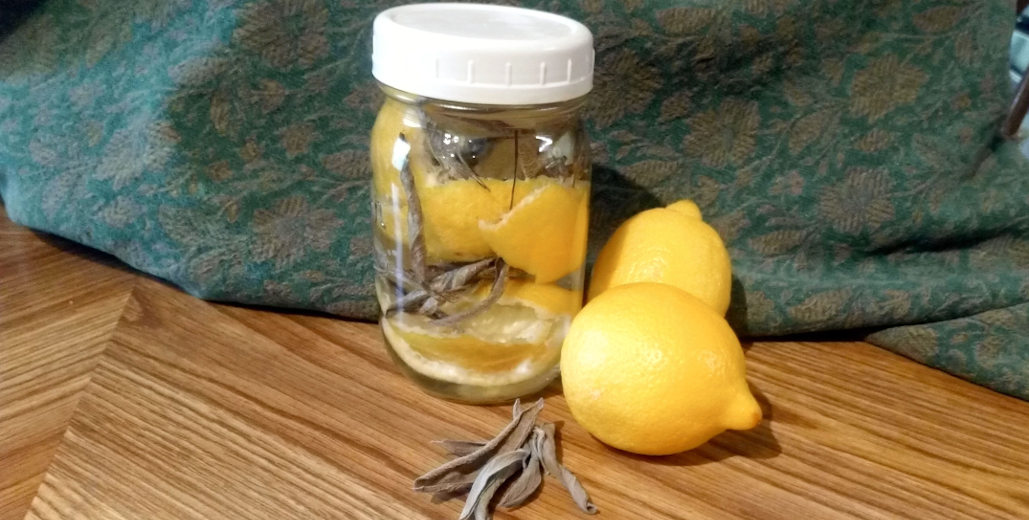
citrus peels and dried sage leaves
Citrus peels and dried sage leaves. I used two large lemons to make one pint of cleaner.

First, wash your fruits and rinse thoroughly. Peel the fruits and save the juice for another use. You may use only one kind of citrus peel, or a variety if you like. I have used grapefruit, lemon, and clementine peels to make this cleaner. They all smell wonderful!

If you are using large citrus fruits like grapefruit, you will probably only need one grapefruit to make a pint of cleaner. However, if you choose to use lemons or limes, you will need several of them to fill your pint jar with peels.

If you don’t have enough citrus peels at one time, you may store them in a zip-top bag or small air-tight container in the refrigerator for a day or two, until you have enough to mostly fill a pint jar.

Freshen up your home with this homemade citrus and sage cleaner! Just a few minutes of prep time is all you need for this natural cleaner.
You can layer the citrus peels and sage leaves for a prettier appearance. This also helps keep the leaves submerged in the vinegar.

Place the citrus peels in the pint jar. The jar should be more than half full, but not overflowing. Add the sage leaves, or other herbs if desired. Again, the jar should not be full to the brim. Pour vinegar over the peels and herbs until they are completely covered. Screw a lid on the jar tightly.

Set the jar in a cool, dark place for about two weeks. Shake the jar every few days (if you remember!). You may let the peels and herbs infuse for 10 days to 3 weeks.

When the cleaner is ready, strain the solid peels and herb leaves out and discard. Measure the liquid and add a roughly equal amount of water. You can use the cleaner in a spray bottle, or merely keep it in the jar and dampen a clean rag with the mixture when you need it.

Store the cleaning solution tightly covered, away from direct sunlight and out of reach of small hands.

Enjoy using this natural, homemade citrus cleaner in your home! The fresh citrus and herb scent is surely much nicer than harsh chemicals!

Freshen up your home with this homemade citrus and sage cleaner! Just a few minutes of prep time is all you need for this natural cleaner.

For more cleaning solutions and household hints, check out these vintage cleaning tips!

Happy homemaking!

~Kimberly

Posted on 7 Comments

The Privilege of Being a Homemaker

Is homemaking a privation or a privilege? Explore the dignity, authority, and creativity of the homemaker's vocation.
Is homemaking a privation or a privilege? Explore the dignity, authority, and creativity of the homemaker’s vocation.

It’s no secret that homemaking gets a bad rap these days. Even among women who have consciously chosen homemaking and embraced it as a vocation and way of life, there are still plenty of days when it’s hard to remember why exactly we wanted this!

Sure, homemaking has its challenges and frustrations. Everything that’s really worth doing is challenging. That’s how we grow as human persons: by meeting new challenges and finding ways to overcome them. But instead of always focusing on the negatives, did you ever stop to think about homemaking as a privilege?

Homemaking: privation or privilege?

At first glance, it seems silly to refer to homemaking as a privilege. After all, you don’t need to achieve a certain level of wealth or education to become one. You don’t need a high social status–in fact, becoming a homemaker usually lowers your social status! You don’t need to be particularly smart, or strong, or beautiful to qualify for this position. All you need is a husband who supports you.

Why then should we consider homemaking a privilege?

It’s not because, as some might insinuate, homemakers get to sit around and eat bonbons all day while their husbands do all the work. That idea is entirely unfounded. Most homemakers throughout history have not had the luxury of hired cooks and housekeepers, unless they were quite wealthy.

No, most homemakers do their share of work; laziness is not more common among these women than the rest of the population.

Homemaking is a privilege because it makes the woman the queen of her household. It gives her authority over countless decisions that must be made on a daily basis. Further, it provides opportunities for creativity as well as nurturing and caring for others. It allows her to use her womanly gifts and talents directly for the good of her family. In other words, homemaking allows women to express their femininity through their vocations.

The Dignity of the Homemaker’s Role

A century ago, women’s rights advocates saw professional jobs and salaries as desirable privileges, and they fought long and hard to make these available to women as well as men. Perhaps the right question to ask is: why did they see secretaries as more privileged than homemakers?

One common argument was that working outside the home gave women more dignity. If the job in question was a professional one, such as a physician or a college professor, I can understand that there is an inherent dignity in those positions. But I hardly think that working in a factory or as a secretary carries the same dignity.

Indeed, it seems that in abdicating their role in the home for many if not most jobs, women lost dignity. They went from being in charge of the daily life of their households to jobs that barely required them to think for themselves, let alone make decisions and be responsible for other people.

The role of the homemaker carries with it a special womanly dignity. It makes the wife the queen of her little kingdom, her home. It gives her responsibility to care for her family: feeding them, clothing them, keeping the house neat and clean, and making their home a haven. Homemaking allows the husband to exercise chivalry by working to provide for his wife and family. It shows the children how mothers and fathers can maintain a strong and healthy relationship by their mutually supportive roles.

When traditional roles are abandoned

When husband and wife both work outside the home, their roles lose definition and become interchangeable. Man and woman are both performing the role of breadwinner, which can lead to competition in their relationship rather than teamwork.

Meanwhile, who is left to take care of the home and the children? Sometimes the duties are split evenly, but more often, the wife must try to juggle most of the cooking, housekeeping, and raising children along with her career.

This situation is not ideal, for anyone involved. The husband suffers, because home is chaotic instead of restful. The wife suffers, because she is too busy and overextended to do her job well. Most of all, the children suffer. They are passed along from daycare to the school system and after-school activities, summer camps and sports leagues. They are raised by everyone except their parents, who are just not home.

Even loving parents who truly want the best for their kids often don’t see the value of homemaking. They think that, in order to give their children the best life possible, they should both work so that they have more money, and can buy their kids more toys and clothes and college educations.

The Authority of a Homemaker

Another argument of women’s rights advocates was that women had no authority in the home. No doubt, there are some husbands who micromanage their wives and homes, but these are surely the exception rather than the norm. Most husbands would be glad to leave much of the household affairs in the competent hands of their wives. All of the homemakers whom I have had the privilege of knowing appear quite satisfied with the authority they exercise.

How does a homemaker exercise authority, you may ask. In what does it consist?

Part of the homemaker’s role as “queen of the household” involves her authority over all the daily events of her family, both planned and unplanned. As mistress of the house, she is the highest authority while her husband is not present. She oversees projects and repairs within and without the house. She is in charge of household management, and delegates tasks to appropriate helpers. She answers questions and solves problems when they arise. She keeps home life running smoothly.

Authority of a working woman

Compare this to the role of a woman who works outside the home. When she is hired by a company, she becomes a part of its hierarchy. She may be responsible for others, or not. She is certainly held accountable to her supervisor, or manager, or the owner of the company. Even if she rises to the top of the corporate ladder, there are boards of trustees or professional bodies that function as checks and balances to her power.

A married woman in charge of her household enjoys, ideally, equally shared authority with her husband. They work together as co-founders of their household and family. But practically speaking, homemakers make more decisions about the home and family life, simply because they are always present. They are, in a sense, the life or the heart of the home.

Creativity as an Expression of Homemaking

Homemakers are the heart of the home. Their very mission is to breathe life and love into a physical dwelling, to turn an empty house or apartment into a home.

We have all been in houses that don’t really feel lived in. They feel stuffy and forced, almost as if they aren’t real. And they’re not: not real homes, that is. They are houses that are still waiting to be transformed into homes.

When you enter a true home, it feels like an extension of the family who lives there. I’m not talking merely about the expense of the furnishings or the style of the decor. Homes are an expression of a family’s values, their ideals, and their interests.

Women are nearly always responsible for creating this feeling of home. They are naturally equipped for nurturing others, and creating cozy, welcoming spaces for their families and guests. Of course working women can use their creative talents in their homes, and many do, but homemakers have a definite advantage: they spend most of their time at home, so they have more time and opportunities for domestic creativity.

Again, you don’t have to be wealthy to exercise this creativity. Even families living in trailers or rustic cabins lacking modern amenities can find ways to make their homes prettier and more comfortable. How? That’s the beauty of creative expression. Love and creativity always find ways to improve a situation, especially when it’s less than ideal.

Receptive Creativity

Gertrud von le Fort said that creativity is linked to receptivity. True creativity is always receptive to Divine inspiration. When people forget this quality and use creativity only to express what they find inside themselves, it breaks down into unintelligible chaos. (Think modern art.)

On the other hand, when the artist is receptive as well as expressive, his or her creations reflect truth and beauty. They are unique, as each human person is unique; and yet, they follow the Divine imprint that is present in the world. Masterpieces are beautiful because they conform to certain principles, and attempt to capture the truth and beauty of the subject.

Indeed, artists, perhaps more than anyone else, are attuned to the patterns and laws of nature and humanity. Their special gifts help them to uncover these Divine fingerprints and bring others to see them through art and music.

Women, who are naturally more receptive than men, have an easier time with this aspect of creativity. Women are more ready to sit with others and try to understand them before deciding how to solve their problems. This is why so many women have a knack for artistic pursuits such as interior decorating, flower arranging, and so much more. It comes naturally to them to try to understand the room or the flowers they are working with, so that they can see how to arrange each item to its greatest advantage.

This vision through understanding is sometimes called intuition. Intuition is grasping something as a whole instead of breaking it down into parts. Again, it is universally agreed that women as a group are more intuitive than men. Intuition greatly aids creativity by this very receptivity to the essence of things.

The Value of Homemaking

Some people think that homemakers don’t contribute anything to society. After all, they’re not “producing” anything. Or are they? Homemakers contribute very materially to society by nurturing their families. Families are the building blocks of society, and strong families are what keeps each society flourishing and functioning smoothly. So it is more correct to say that homemakers are invaluable to any and every society. There can be no more important role in forming good citizens than that of a homemaker.

How do you reckon the value of a homemaker? Well, what is the value of a home? Look at those who grow up in broken homes, or no real homes at all. They are often angry, anxious, depressed, and confused. As young adults, they lack direction in life and social skills necessary for getting along well with others. They often make poor choices, and involve others in their dysfunction.

There are exceptions, thankfully. With grace and perseverance, anyone can break out of a dysfunctional routine. But isn’t it better to start out with a home and family that is loving, nurturing, and provides the best possible basis for the success of each person? Isn’t it better to build a society on a solid structure of normal, functioning families, rather than dysfunctional families and every-man-for-himself individualism?

The family is the building block of society. As more and more families start to crumble, the society they live in weakens. Homemakers are the defenders of the family, and therefore society. They build up their homes and neighborhoods through the bonds of love and solidarity.

Today, this work is too often passed over as unnecessary, uninteresting, and unfulfilling. It is no less important because it is unpopular, however. In fact, the more unpopular homemaking becomes, the more important it is to the fate of families and societies alike.

Authentic Femininity and Homemaking

Women who seek authentic femininity embrace being women. They are not trying to be more like men. They accept the differences between men and women with equanimity, instead of constantly trying to erase all differences, good and bad.

These women see that they have different gifts and talents than men, and this is a good thing. It allows men and women to cooperate and work together in marriage, as well as in other relationships. Recognizing that women have different strengths and weaknesses than men allows them to maximize their potential to help each other.

The opposite view holds that women are unfairly subjugated to men in most if not all spheres of life, and that every effort should be made to eradicate these inequalities. In this view, oddly enough, only masculine strengths and virtues are esteemed.

The fact that men tend to possess more of these masculine virtues is said to be caused by the suppression of women’s rights, while feminine virtues and strengths are not even mentioned. This is a philosophy of inequality, and the goal of its proponents is to remove all differences or inequalities: to “level the playing field.”

Authentic femininity does not denigrate true feminine virtues and strengths. Rather, it embraces all of the feminine characteristics which are good, and seeks to help women attain happiness in their womanhood.

Homemaking is a deeply feminine calling. The art of making a home and nurturing a family resonates with the feminine heart. The homemaker who has embraced authentic femininity sees the four walls of her home, not as a confining prison, but as the boundaries of her own little kingdom, and a blank canvas for her creativity.

Is homemaking a privation or a privilege? Explore the dignity, authority, and creativity of the homemaker's vocation.

Further Reading

If you enjoyed this article, you may also enjoy: