Posted on 3 Comments

The One Thing You Should Do Every Morning to Increase Productivity

Do you know the one thing you can do each morning to increase your productivity at home?
How did our grandmothers get so much done in a day? Here's a simple tip that will boost your productivity at home.
How did our grandmothers get so much done in a day? Here’s a simple tip that will boost your productivity at home.

Do you find yourself stuck in a rut, just trying to get through the day and finish everything that needs to be done? Do you feel like you can’t accomplish anything? Maybe you start one task, then go on to another without finishing the first. Wouldn’t it be great if there was a flip you could switch on your brain to throw it into Productive Mode?

Well, there’s no magical switch that I know of, but there is something you can do to boost your productivity and give you more focus, even when you spend all day at home. 

It’s very simple, and only takes a few minutes in the morning. But it makes a huge impact on your mindset and productivity throughout the day. I know it helps keep me focused and moving forward, even on mornings when I would rather still be in bed. What is this one thing every successful homemaker or work-from-home-er does every morning?

Dress intentionally for your day

If someone showed up to an interview wearing pajamas or yoga pants, would you take her seriously? Would you think she looks like a responsible, hardworking employee who will be an asset to your company? 

Not likely. You would probably think that someone who cares so little about her appearance isn’t likely to care about her job.

And you would be right. Our attire reflects our level of respect for an occasion, person, or occupation. That’s why we dress a little nicer for church, parties, date night, or important meetings.

Professionals often wear suits or uniforms to work every day, because their jobs are worthy of respect. But do you ever stop to think about how you dress for everyday? 

Maybe you think it doesn’t matter, since you work at home where no one will see you except your family members. Wait just a minute! Aren’t your family members the most important people in your life? If I respect and love my family, I want to give them my best. Part of that is dressing like a lady. 

Moreover, dressing intentionally for your job makes you take it seriously. Homemaking is an important job, and it deserves your respect.

Attire affects your actions

Did you know that the clothes you wear actually impact your attitude and thinking ability? If productivity is your goal, regardless of your occupation, dressing with intention can help. Several studies have shown that dressing in a professional manner (instead of casual clothing or loungewear) can increase abstract thinking and negotiation skills. 

How do you apply that to homemaking, exactly? I’m not going to wear a blazer or a white blouse to hang laundry and change diapers any time soon!  But I have noticed that I do feel much better on the days when I wear a dress, compared to the days when I’m still in my exercise clothes at noon.

It’s hard to take yourself seriously when you’re wearing an old t-shirt and sweatpants. So put some thought into your attire, and find an outfit that’s suited to your job but also makes you feel put together and ready for your day.

You will feel better about yourself and your role, and you will begin to be more productive as well!

How do you dress intentionally for homemaking?

Let’s be clear: I’m not recommending that you should start wearing a suit or a uniform every day. That would not be suited to your role in the home. 

I aim for outfits that are both pretty and practical. That way, I can treat myself and my job with respect. 

I feel best when I’m wearing a dress. That doesn’t happen often right now, since I have a baby and most of my dresses aren’t nursing-friendly. However, a pretty skirt and blouse or even a well-fitting top and jeans can be good substitutes.

There is no specific uniform for homemakers (thank goodness!), but dressing tastefully and neatly is always attractive.

Dressing like a lady doesn't have to be fancy. Pretty aprons make housework more fun!
Pretty aprons make housework more fun!

Love those aprons!

If you’re still skeptical about wearing nice clothes for housework, let me introduce you to aprons. These are some of my favorite items of clothing, and for good reason! Aprons allow me to wear pretty clothes all day long without getting them dirty (unless your baby has a talent for wiping his grubby hands on the places an apron doesn’t cover!). 

If you get one with fun prints or trims, it can also add a pretty touch to a plain outfit. When I wear a dress and an apron all day, I feel like an old-fashioned housewife. That might not be appealing to everyone, but you can still rock an apron and jeans! I’ve done that too.

I have four or five aprons right now, all in different styles, colors, and prints. I can match them to my outfit, mood, or task. When I don an apron, that means business. It helps me to get in the mode of working steadily through my to-do list, despite any hindrances that may arise.

Of course, your attire should be suited to the tasks you need to accomplish each day. There will probably be days when it’s completely reasonable to wear old clothes for particularly messy tasks. But those exceptions don’t change the standard of neat, careful dressing which is so important to your mindset and mood.

Why does dressing like a lady make you more productive? 

You don’t need to get dressed up in heels and pearls to do the cooking and cleaning, but wearing attractive, well-fitting clothes will help you to feel more poised and confident in your role as a homemaker.

As I mentioned above, there have been a number of interesting studies about people’s responses to clothing (their own or that of others). Even if you don’t think your clothes are particularly important, there is apparently some sort of inner mechanism that pays close attention to a person’s attire. 

You may have heard the old saying, “Dress for the job you want, not the job you have.” This doesn’t mean that you should wear something unsuitable for your present position; rather, it means that scaling up your dress code just a notch can boost your confidence.

I’ve heard numerous women say that they are treated better when they wear a dress. I myself have experienced this on several occasions, but more important to me is the way wearing a dress makes me feel. 

Wearing a dress around the house makes me feel like I've just stepped into the pages of "Little House on the Prairie!"
Wearing a dress around the house makes me feel like I’ve just stepped into the pages of “Little House on the Prairie!”

It doesn’t have to be a fancy dress for date night: even a casual dress or a coordinating skirt and blouse makes me feel more positive and confident. I tend to smile more, stand straighter, and look about me more often. I also have an easier time focusing and organizing my tasks.

Of course there are still the usual distractions and annoyances, no matter what you choose to wear, but dressing like a lady somehow prompts me to act like a lady and sail through them serenely.

Bonus Points: Hair and Makeup

Speaking of dressing like a lady, it doesn’t stop with clothing. A lady’s appearance is neat and clean: well-kept is a fitting description. If you wouldn’t go out without curling your hair (or at least brushing it!) and a swipe of lipstick, try to keep that ladylike appearance at home. 

I’m not saying you should dress up on sick days or a lazy vacation weekend, but at least on your work days when you have homemaking tasks to accomplish.

This is a hard one for me, but I do feel better if my hair isn’t tumbling out of a messy bun all day long! Taking a few extra minutes to fix my hair neatly in the morning really makes me feel put together and ready for the day.

And that’s the goal, isn’t it? We would all like to feel confident and ready to handle whatever life throws at us each day.

Last but not least, smile!

There’s no doubt that the type of clothing you wear impacts your productivity and confidence. But there’s something even more important than clothes could ever be: your attitude. 

If you’re sullen and grumpy all day, no apron is going to change that. Not even a tailored suit would! 

A cheerful countenance and positive attitude, on the other hand, starts you out on the right foot and sets you up for a more pleasant day. It sets off a chain of positive interactions with others around you, which in turn helps you to stay positive!

Now, most of us have days occasionally when we just wish we could stay in bed and not have to face the world. (Well, I have those days, anyway.) When I’m feeling grouchy and everything seems dark, it’s even more important for me to take a few minutes by myself to get ready for the day. Then I can freshen up my attitude at the same time.

So the secret to success as a homemaker is to start with a positive attitude and then dress like a lady. Make this a habit, and you will become more poised and purposeful in your home.

Happy homemaking!

~Kimberly

Do you know this one simple tip to increase your productivity every day, even when your work is at home?
Posted on 5 Comments

Simple Strawberry Jam with Dutch Jell

Strawberry jam is simple to make with this quick and easy recipe!
strawberry jam is simple to make with this quick and easy recipe!

There is a short way to make jam, and there is a long way. The long way involves cooking fruit and sugar until the mixture begins to thicken on its own. The short way uses added pectin to speed up the process. 

In general, I like to do things the old-fashioned way, which is typically the longer way. However, there are times when I just need to make jam and don’t have all day to do it! This recipe is simple, fail proof, and takes less than an hour from start to finish! Oh, and the jam is also delicious.

Today was one of those days when my to-do list seemed endless and the children clamored constantly for my attention. It was definitely a day for quick jam-making.

I’ve had strawberries sitting in my refrigerator for nearly a week, begging me to turn them into jam. I kept postponing Canning Day because I was busy preparing goodies for a bridal shower. Now that the shower is over and my kitchen is starting to resume its normal appearance, I had time to focus on jam.

This post contains affiliate links. If you click the links and make a purchase, I may receive a small commission. You can read my full disclosure here.

What equipment do you need to make jam?

  • Water bath canner or pressure canner tall enough to cover your jars with an inch of water. You can substitute a large pot if necessary, if you have a rack to hold the jars up off of the bottom of the pot.
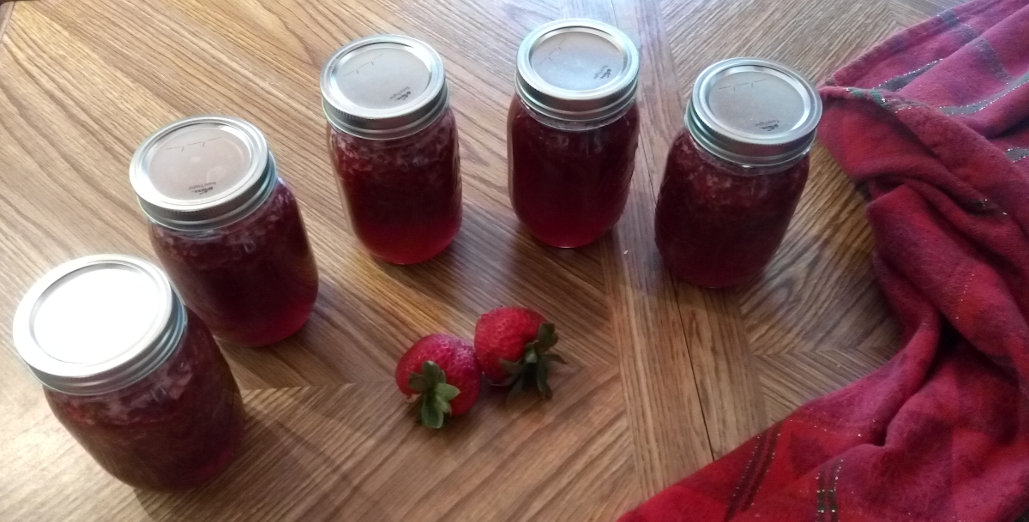
  • Canning jars, lids, and rings. I used 5 pint jars for this recipe.
  • Large stockpot for cooking the jam
  • Potato masher for crushing the berries
  • Wooden spoon
  • Ladle
  • Jar lifter
  • Canning funnel
  • Clean tea towel

The process of making jam using pectin really doesn’t take long once you gather all of your equipment. In fact, what takes the most time is waiting for the water in your water bath canner to boil. I suggest filling that first, before making the jam, so it will be hot by the time you need it.

Sterilizing Jars

There are several different ways to prepare canning jars. The basic concept is that jars and lids need to be sterilized before they are used to store food, or the contents may spoil. Also, the jars should be hot if you are going to fill them with hot jam. Filling cool jars with hot foods may cause the jars to crack.

One way to sterilize jars is to run them through your dishwasher. Another way is to boil them in a pot of water for a few minutes. 

I usually place my empty jars, along with unscrewed rings and lids, in the water bath canner while it is heating. If you don’t want to fish the rings and lids out of a tall pot of boiling water, try boiling them separately in a small pot.

This simple strawberry jam recipe yields 5 pints in under an hour. It is made with Dutch Jell, a natural powdered pectin.

Ingredients

Quick-cook jams can be very simple. For this recipe, you need only strawberries, sugar, and powdered pectin. I use Dutch Jell, but you can substitute a box of another powdered pectin if you wish.

Dutch Jell is a powdered pectin that is sold in bulk packages. I make sure to restock my supply when I visit my in-laws in Pennsylvania, but you can also find it online. The original recipe for strawberry jam from the Dutch Jell company suggests using a rounded 1/3 cup for each batch. This made my jam a bit too gelatinous for my taste, so I just use a level 1/3 cup.

The strawberries should be at their peak of ripeness. If they are underripe, the jam won’t have much flavor. Rinse the berries in cool water and cut off any bad spots with a paring knife.

As for sugar, I have used granulated white sugar and evaporated cane sugar with equally good results. 

Method

Fill your water bath canner with water to about the height of your canning jars. Once you place filled jars in the canner, the water should be deep enough to cover them by about an inch. Place the canner on your stovetop and heat it over the largest burner while you prepare the jam.

If your strawberries are large, cut them into quarters. Small berries may be halved.

Rinse the strawberries under cool water. Hull them and cut off any bad parts with a paring knife. If the berries are large, cut them in quarters; halves are fine for smaller berries. Transfer the berries to a large stockpot. Crush them with a potato masher until they are soupy and no large chunks remain. Unless, of course, you happen to like large chunks in your jam!

Crush the berries in a large stockpot to release the juices. A potato masher works well.

Add the Dutch Jell to the strawberries in the pot and stir well. If you are using a different brand of pectin, read the directions to make sure you add the pectin at the right time.

Measure the sugar into a large bowl. It needs to be added all at once, so don’t wait until the jam is boiling to start measuring it!

Add the sugar to the strawberries all at once.

Bring the berries and Dutch Jell to a boil, stirring frequently. Add the sugar all at once and continue stirring until the mixture begins to foam up. Skim off the light pink foam with a large spoon or a measuring cup. Don’t worry if you don’t get every bit of foam; just stir it back into the jam.

When the jam foams up, skim the light pink foam off the surface. Don't worry about getting every last bit, or you'll remove too much jam along with it.
When the jam foams up, skim the light pink foam off the surface. Don’t worry about getting every last bit, or you’ll remove too much jam along with it.

Once the jam comes to a full rolling boil, continue to cook the jam, stirring constantly, for one minute. Remove from the heat.

Prepare your workspace so that everything is within reach while you’re working with the hot jam. Carefully remove the hot jars, lids, and rings from the boiling water. 

Making strawberry jam: ladling into jars.
Prepare your workspace so that everything is within reach. Place the jar close to the pot of jam to prevent drips.

Set one jar next to the pot of jam. Set the canning funnel in the mouth of the jar. Ladle jam into the jar, leaving ½” of headspace (this should be about level with the bottom of the canning funnel). 

Remove the canning funnel from the jar and set aside. Dip a corner of the clean towel into the pot of hot water. Use it to wipe all around the rim of the jam-filled jar. Sticky residue on the rim can interfere with the seal.

Wipe around the rim of the jar to remove any sticky jam residue.

Place a lid on the jar, then screw a ring on. You may want to hold the hot jar with a towel or pot holder. Screw the ring until it is fingertip-tight. You don’t need to screw it on as hard as you can!

Set the jar into the water bath canner, using the jar lifter. Repeat the process with the remaining jars. If you have some jam remaining which doesn’t quite fill a jar, don’t try to can it. Just refrigerate the partially-full jar after it cools, and consume it first.

Canning strawberry jam: boiling water bath
Use a jar lifter to place jam jars into the canner. Be careful of the hot steam!

Once all the jars have been filled and placed in the water bath canner, check the water to see if it is still boiling. If not, cover with a lid and return to a boil. 

When the water boils, set a timer for ten minutes. The canner does not need to be covered during the boiling water bath. Leave the jars undisturbed in the canner for ten minutes, then remove them one by one with the jar lifter and set aside to cool. 

You will hear a popping sound when each jar seals. This can take a few seconds up to several minutes. 

Mmm, fresh strawberry jam with sourdough bread. What a treat!

After the jars have cooled, don’t forget to label them with the date and contents! Strawberry jam will keep in sealed jars at room temperature for over a year.

strawberry jam is simple to make with this quick and easy recipe!
Print Recipe
2 from 1 vote

Simple Strawberry Jam with Dutch Jell

Looking for a quick and easy strawberry jam recipe? This recipe yields 5 pints of jam in under an hour!
Prep Time10 minutes
Cook Time10 minutes
Boiling Water Bath10 minutes
Total Time30 minutes
Course: Condiments
Keyword: Jam, Strawberries
Servings: 5 pints

Equipment

  • Water bath canner or pressure canner
  • pint jars, lids, and rings
  • stockpot
  • potato masher
  • wooden spoon
  • ladle
  • jar lifter
  • canning funnel
  • clean tea towel

Ingredients

  • 2 lbs. strawberries rinsed, hulled, and quartered
  • 7 cups sugar
  • 1/3 cup Dutch Jell powdered pectin

Instructions

  • Fill a water bath canner or pressure canner with water to cover your jars. Set it over high heat and bring to a boil.
  • Sterilize jars and lids in boiling water or in your dishwasher.
  • Place strawberries in a large stockpot and crush to release juices. Stir in Dutch Jell. Bring to a boil over medium heat, stirring occasionally.
  • While the strawberries are cooking, measure the sugar into a large bowl. When the strawberries begin to boil, add the sugar all at once and stir well until combined.
  • Return the mixture to a boil, stirring frequently. Skim foam off the surface with a large spoon or a measuring cup. Boil and stir the jam for one minute, then remove from the heat.
  • Ladle jam into hot jars, using a canning funnel. Wipe around the rim of each jar before placing a lid on it. Fingertip-tighten the ring around the mouth of the jar.
  • Use a jar lifter to place the jars into the water bath canner. Boil for 10 minutes, then remove jars to cool.
  • When the jars have cooled, check the seals and label the jars with contents and date. Strawberry jam will keep in sealed jars at room temperature for over a year.

Notes

You may substitute other brands of powdered pectin for the Dutch Jell. 1/3 cup Dutch Jell is equal to one box of powdered pectin. Be sure to read the instructions on the box before proceeding with the recipe.
3 ingredients is all it takes to make delicious strawberry jam in under an hour!
Posted on 17 Comments

How to Live Intentionally at Home

Does your life feel unimportant because you're stuck at home? Here's how to live with intention, no matter where you are.
living intentionally as a homemaker
Does your life feel unimportant because you’re stuck at home? Here’s how to live with intention, no matter where you are.

How do you know that you’re accomplishing anything with your life when your world is your household? I’d wager that every homemaker asks herself this question at some time or another.

It has to do with intention and integrity.

Living intentionally means knowing your purpose in life and setting goals to get you closer to that ultimate purpose.

Integrity is making sure your actions align with your goals, so you’re not professing to believe one thing while actually doing something else.

Here are some practical ideas to help you live with intention and integrity, even on the days when you’d rather be anywhere but home. Especially those days.

1. REMEMBER YOUR PURPOSE

Living intentionally starts here. You can wander through life watching the days come and go listlessly, or you can see each one as a new opportunity to learn, grow, and form yourself into the person you were created to be.

If you want to keep growing, but feel like you’re stuck in a rut, it helps to take a step back and remember where you’re headed.

What is your ultimate goal in the eternal scheme of things? What are the smaller goals that help you get there? How does your current job or situation fit into your dreams and goals?

For example, caring for young children every day might never have been your dream. But if raising your children to the best of your ability is important to you, then this period in your life has a purpose.

You don’t have to feel happy all the time if you know that you’re going the right direction, and moving toward your goal.

But if you’re unhappy and your life goals seem unattainable, maybe you’re aiming at the wrong goal.

Maybe it’s a goal you set for yourself years ago, and you’re not the same person now. In that case, you might need to do some deep thinking about whether or not the goals need to change.

But if your goals are sound, you can feel confident that you’re headed in the right direction. This may not sound like a big deal, but it makes your daily duties more meaningful- and therefore more bearable.

Homemaking isn't the most glamorous job, but t is necessary and worthwhile. Here's how to keep a positive attitude at home by living intentionally.

2. DON’T GET DISTRACTED

It’s great to fix your eyes on a goal, especially when you’re going through tough times. Just be careful that you don’t let that goal absorb all of your attention, or life will slip away from you.

Another bad habit is to let yourself be continually distracted. Media, in its many forms, is the number one distraction for most people today.

It is so easy for us to fall into this habit, myself included! But it’s so destructive. Before you know it, you’re paying more attention to a screen than to your spouse, kids, or God.

When this happens, we find ourselves living a lie: we say that our faith and families are important, but if something else is taking up most of our time, that can’t really be true.

How can we stop getting distracted? Take time to really be present- to live in the moment- at least once a day.

Put away your phone. Shut off your computer. Feel the warm sun or cool rain on your face. Smell the damp earth. Listen to your children. Look your spouse in the eye and have a heartfelt conversation.

It may seem strange at first, accustomed as we are to distractions. But living in the present moment gives your life richness. We are not machines, working mechanically with no self-awareness.

When we take the time to look around and become aware of our surroundings, we can appreciate not only the tangible world around us, but also things like beauty, goodness, and humor. Awareness of these is what makes human life so amazing and precious.

Your life is amazing and precious! Don’t let it slip away while you’re distracted.

3. MAKE YOUR HOME A PLACE WHERE YOU WANT TO BE

Please don’t take this to the extreme. I am not recommending a total renovation of your house here. But if you spend most of your time at home, why not add some personal touches to make it a place where you truly enjoy being?

Perhaps most people don’t need to be told to get creative and make their house look nice. But I admit that I have trouble with it.

I’ve been renting for the past eight years (four different places), and it’s hard for me to justify spending money on furniture or decor items when I know that we’ll be moving again. As a result, none of our furniture matches, and there are only a few pieces that I actually like.

We got a new (used) couch recently, and it made me realize how much I had disliked the old one. I actually enjoy looking at and sitting on this one! What a difference it makes when you like your furniture, instead of just putting up with the least expensive option.

Again, I’m not suggesting you go out and buy lots of new furniture. Maybe all that’s needed is a rearrangement of what you already own.

But if there are pieces you really dislike, see if you can start replacing them slowly. It might take a while; that’s okay. This can be a long-term project.

But this section isn’t only about furniture. What else can you do to make your home a pleasant place to live?

  • Set out a vase of fresh flowers or some potted houseplants
  • Hang some cheery curtains
  • Open a window and enjoy the breeze
  • Bake something delicious
  • Use pretty tablecloths, place mats, or napkins
  • Make a pretty tea shelf or cabinet to store your favorite teas and accessories
  • Light a candle (or two)
  • Clear the clutter
  • Display the things you love where you can see them
  • Turn off unnecessary noise and distractions

What else can you think of?

What should I do tomorrow? Start living intentionally.

4. GET SOME FRESH AIR

Now that you’ve made your house a welcoming and pleasant place to live, it’s time to leave it for a while. Make it a goal to get outside every day, even if it’s just for a few minutes. Sunlight and fresh air can work wonders for a tired, drooping spirit- and you don’t have to live in the tropics! 

I just spent a long, cold, Alaskan winter inside our little cabin. I barely poked my nose outside for over two months. For me, that is no way to live. I need fresh air! When I finally did venture out again, I felt so much better, even though it was still cold. 

Spending time outside, even just 10-15 minutes, refreshes my mind and melts my worries away. Sometimes your house becomes a cocoon insulating you too snugly from the rest of the world. Stepping outside reminds you that there’s a whole big world out there, and you’re part of it!

How can you convince yourself to start spending time outside? Plant some flowers or herbs. Hang your laundry out to dry. Take walks around your neighborhood. Ride a horse- or a bicycle. Go for a hike. Meet a friend for a picnic. 

Even in the winter, there are plenty of outdoor activities: walking, ice skating, snow shoeing, and skiing, to name a few.

Yes, it’s cold in the winter. It’s hot in the summer. Sometimes it’s raining, or windy. Maybe you’re just too busy. I can always come up with an excuse to stay indoors if I don’t feel like it. 

If you find yourself doing this, ask yourself: Would I rather experience a little discomfort and get outside, or stay stuffy and cranky indoors?

If you choose to ignore your excuses and go outside, you won’t regret it!

5. FILL YOUR DAYS WITH MEANING, NOT BUSYNESS

Don’t fall into the trap of thinking you’re productive just because you’re busy. You’re only productive if you’re making progress toward your life goals. 

There are a million things you could do each day, but you don’t have to do all of them. Busyness is not a virtue.

If you’ve thought about your life’s purpose and established goals, you can look at all the things you do each day and determine whether they are helping or hindering your progress toward these goals.

Sometimes something comes up unexpectedly and demands your attention. I’m not talking about those because you can’t control them or prepare for them. But there are probably a lot of things you do each and every day. They’re habits. 

Habits contribute to busyness because we keep doing the same things over and over without really evaluating their effects. Unproductive habits merely waste time and distract us from what’s really important. Before we know it, we don’t have time for anything extra, and maybe not even for the things and people that are truly important.

This is not a good way to live. It’s a recipe for burnout and discouragement. What can you do to fix it?

Start evaluating your habitual actions, and the things you do over the course of a normal day. It’s probably easiest to examine them one at a time, as you start to do something out of habit, instead of all at once.

Ask yourself if the habit is getting you closer to your goal, or driving you farther away from it. Some actions don’t seem to be related at all, initially.

Take, for example, brushing your teeth. This is not a morally good or bad action, and it might not seem connected to any of your life goals. 

But it’s part of caring for your body, and contributes to your overall health. So if you aspire to be healthy, then brushing your teeth helps you accomplish this goal. Likewise, if you aspire to be neat and tidy, brushing your teeth helps with that goal, too.

Some actions might be helpful in small doses, but quickly become counter-productive if you spend too much time on them. I’m thinking of social media specifically, which is a terrific time waster! I am ashamed of how much time slips away from me in this manner when I’m not careful. 

Even if you don’t use social media, don’t think you’re immune to this! There are plenty of other habits that fall into this category.

Make sure your habits are helping you become a person you respect. If they’re not, stop now- and cultivate a new habit in its place. 

This is more effective than merely trying to stop an ingrained habit. If you don’t replace it with something, you will feel like something’s missing, and you’ll be more likely to slide back into the bad habit you stopped. 

Replacing a negative habit with a positive one is essentially distracting yourself. It’s hard to stop a habit, especially if it’s an old one. Cultivating a new habit at the same time really does help, because you probably won’t have time for both!

6. START FRESH EACH MORNING

You probably don’t reevaluate your life’s purpose every single day. It’s not necessary, if you’ve formulated goals and identified what you need to work on to achieve them.

But even if you’ve done this, it’s still easy to get caught up in the multitude of urgent issues demanding your attention. It’s easy to go from one thing to another from morning till night, and repeat this for days or weeks without pause.

By the time you finally raise your head and remember your goals, you might be off track a little- or a lot.

How do you keep your sights focused on eternal goals in the midst of everyday life?

Start every morning with a brief reminder of why you’re here and where you’re going. 

That might be a morning prayer or offering, dedicating all your work and all you do each day to the Lord. It might mean writing down some of your long-term goals and looking at them every day, so you can keep yourself focused on them throughout the day. 

Another practice I find helpful is to start the day by determining the one best thing I can do today. Then I do it. Maybe not first thing in the morning, but I will get it done if I start the day determined to do so.

Your one best thing doesn’t have to be a huge and noble task. Sometimes it’s writing a letter to a friend or family member. Sometimes it’s cleaning up a pile of clutter that you’ve been ignoring. Sometimes it’s asking yourself a difficult question that you don’t want to think about.

Start small. Determining to do one good thing each day might seem like nothing, but even small acts of love keep you aiming upward and moving toward your goals.

When you're home all day, life can feel boring and unimportant. That's why it's so vital to live with intention and integrity. Learn how even mundane, everyday routine has a meaning and purpose.

7. BE GRATEFUL

The best way I know to banish a negative attitude is to be genuinely grateful for your blessings. So many things have been given us, which we did nothing to deserve. Every one of us has many reasons to be grateful.

But you can’t be grateful at all if you’re focused on yourself. (I’ll be the first to admit that I focus inwardly all too often.) This inward focus makes yourself the center of the universe, and it skews all of your relationships. 

That’s why the opposite of love is selfishness, or self-love. Love focuses outward, on other people. It wants the best for them (and not out of false piety, which really glorifies itself). Selfishness focuses inward, and hoards the best for itself.

To have a grateful spirit, you need to know your place in the world. This is called humility: realizing just how small you are, and yet how significant, how precious your life is.

When you can see yourself, other people, and the world itself in their proper relationships, then you can begin to see goodness, and be grateful for it.

You begin to see through the lens of gratefulness, and discover more and more gifts: a dazzlingly clear sky, the soft sound of raindrops, a baby’s tiny hand, or the worn and callused hand of an old man.

Everything is a gift, if you have the sight to see it.

Set your goals intentionally, and live with integrity

You may have noticed a theme here. Each injunction involves pausing to examine some part of your life, and making adjustments when your actions don’t line up with your goals.

That’s not an accident. You can only move upward if you’ve set a true goal, and setting a goal doesn’t guarantee accomplishing it.

You have to be intentional about the way you live your life if you want to accomplish good or great things. Saints and heroes aren’t made by accident. They are formed through discipline and integrity.

Jordan Peterson captures the essence of what it means to “live properly” in his 12 Rules for Life: An Antidote to Chaos:

Orient yourself properly. Then–and only then–concentrate on the day. Set your sights at the Good, the Beautiful, and the True, and then focus pointedly and carefully on the concerns of each moment. Aim continually at Heaven while you work diligently on Earth. Attend fully to the future, in that manner, while attending fully to the present. Then you have the best chance of perfecting both.

12 Rules for Life: An Antidote to Chaos, Jordan B. Peterson

Get your priorities straight first. Think about your purpose and goals. What do you need to change to become a person that you respect? How can you approach each day as a new opportunity to do good? How can you live today in the light of eternity?

If you enjoyed this article, you might be interested in reading more about The Purpose of Homemaking.

Posted on 1 Comment

How to Stock a Pioneer Pantry + Printable Shopping List

How to stock your pantry like a pioneer

A well-stocked pantry conveys a sense of abundance and homely charm. I’ve always loved walk-in pantries with their wonderful variety of goods. They are like mini general stores, stocked with everything the household needs.

Shelves full of jams and pickles breathe of summer’s bounty even in the midst of winter. Bins of root vegetables and squashes sit in the cool corners, while strings of onions hang from the rafters.

Canisters of dry goods proclaim their ever-ready potential to be turned into hearty meals, while herbs and spices lend a fragrant scent to the little room.

This is my dream for some day, but it was a reality for the pioneers, and for many homesteaders today. When confronted with such a pantry, I feel like I stepped into Little House on the Prairie:

“Laura was so delighted with the pantry that she stood in the doorway for several minutes, admiring it.”

Laura Ingalls Wilder, The First Four Years

Nowadays, not everyone needs such an extensive pantry; and pantries should be practical above all else. But homemakers can still benefit from stocking basic supplies that they use all the time, and preserving garden produce.

Even if you don’t live on a homestead, you can still capture a bit of that practical, homely atmosphere by learning how to stock a pantry in your own home.

Getting Started

Two practical questions to consider when you’re planning out your pantry are: 1) What do I need? and 2) Where will I store it?

If you can answer these two questions, you’re well on your way to learning how to stock a pantry like a pioneer!

What should I store in my pantry?

Pantries should be practical. Store ingredients that you use regularly. If you like to bake, then think about which baking ingredients you can stock up on.

If you only bake once every month or two, then it’s probably not a good idea to buy large quantities of flour and sugar. They might look pretty in glass jars with cute labels, but if you won’t use it before it goes bad, then it’s a waste of money, time, and space.

The same principle applies to any food you decide to store. Don’t buy a lot of something just because it lasts a long time. You have to actually plan on eating it! I suggest you try a small quantity of something new before buying 10-20 pounds of it!

Learn how to build your pantry practically, so it suits your family's needs. A well-stocked pantry can supply your family for months! Includes free printable shopping list!

Storage Spaces

Walk-in pantries seem to be luxuries these days. In many houses, the pantry is reduced to a closet, while small houses and cabins like ours don’t even have that!

What do you do if your house doesn’t have a pantry? Get creative. Look at the storage space you do have. Is there a closet under the stairs? A linen closet in the hallway? Extra space in the basement or garage?

When picking a space for your pantry, look for somewhere that is dark, dry, and cool if possible. If you live somewhere humid, dry isn’t always going to happen; just don’t go storing dry goods in a moist environment like under your sink!

If you don’t have any available closets, you can build one! My pantry for the last two years has been a sturdy wooden chest that my husband built. It’s not quite as convenient as an upright closet with shelves, but it works for us.

Another option is to buy an upright cabinet with shelves. You can find these at auctions, estate sales, and of course, furniture stores.

There’s no rule saying you must store all of your “pantry foods” together. If you don’t have a walk-in pantry, you’ll probably end up using cupboards, closets, boxes, and bins.

Start Slowly

Before you rush out to buy ingredients, keep in mind that stocking a pantry can be expensive initially. It involves buying large quantities of many different items.

As you’re learning how to stock a pantry, you may want to start slowly. Buy one or two pantry items per week, instead of trying to build your perfect pantry all at once. Buying items slowly also helps you keep a goal in mind and not buy unnecessary things on a whim.

Here’s a simple plan for building your pantry slowly:

  • Read through the list of pantry staples below and write up a list of which items would be practical for you.
  • Add any other foods you think would be practical for your household.
  • Bring that list with you to the grocery store so you can stock up on items gradually, as they go on sale.
  • Start replacing store bought items with your own dried herbs and home-canned preserves.

If you follow these steps, you will be well on your way to stocking your pantry like a pioneer!

Want to learn how to stock a pantry like a pioneer? This guide to pantry basics and free printable shopping list are just what you need!

The Basic Pantry Staples

No two pantries are exactly alike, so I can’t give you an exact rundown of what you should stock. You might have a special diet or allergies to work with, besides your own preferences.

Still, I know it can be helpful just to see a list, so you can start to envision what foods you would like to stock, and how much space you will need.

Here is my list of pantry staples, based (loosely) on a pioneer household.

Grains and Flours

  • Unbleached white flour
  • Whole wheat flour
  • Whole grain wheat or spelt berries, if you grind your own flour
  • Rolled oats
  • Cornmeal
  • Rice

A note on flour: whole grain flours should not be stored at room temperature for long periods, because the oil in the germ turns rancid. If you do need to store it for a long time, the freezer is best.

Legumes

  • Pinto beans
  • Kidney beans
  • Navy or great northern beans
  • Other beans (black, small red, lima, garbanzo, etc.)
  • Split peas

Nuts & Seeds

  • Almonds
  • Walnuts
  • Pecans
  • Peanuts/ peanut butter
  • Coconut flakes
  • Sunflower seeds
  • Flax, sesame, or other seeds
Want to learn how to stock a pantry like a pioneer? This guide to pantry basics and free printable shopping list are just what you need!
I’ve covered coffee cans with pretty paper and use them to store dried fruits and nuts.

Dried Fruits

  • Raisins or currants
  • Golden raisins
  • Dried cranberries
  • Dates
  • Others: dried apricots, pineapple, prunes, cherries, or blueberries

Vegetables

  • Potatoes
  • Sweet potatoes
  • Onions
  • Garlic
  • Squashes

Herbs & Spices

This category really depends on your taste. I happen to really like herbs and spices, as you can tell!

  • Salt and pepper
  • Sweet spices for baking: allspice, cinnamon, cloves, ginger, nutmeg
  • Spices for cooking: cayenne pepper, chili powder, cumin, dried minced onion, garlic powder, ground mustard, paprika, red pepper flakes, turmeric
  • Herbs for cooking: basil, chives, dill, fennel, marjoram, oregano, parsley, rosemary, sage, tarragon, thyme
  • Seasoning blends: Italian seasoning, taco seasoning, herbs de provence, etc.

Baking Supplies

  • Baking powder
  • Baking soda
  • Cornstarch
  • Cream of tartar
  • Yeast
  • Cocoa powder
  • Chocolate chips/ baking chocolate
  • Vanilla extract
  • Almond extract

Sweeteners

  • Honey
  • Maple Syrup
  • Molasses
  • Sugar (white or evaporated cane/ sucanat)
  • Brown sugar
  • Confectioner’s Sugar

Oils

  • Coconut oil
  • Palm oil
  • Olive oil
  • Others: avocado, sunflower, walnut, etc.

Canned Goods

  • Tomatoes: whole, diced, sauce, paste
  • Corn
  • Beets
  • Pumpkin
  • Beans, any variety
  • Applesauce
  • Peaches, apricots, cherries, or other fruits
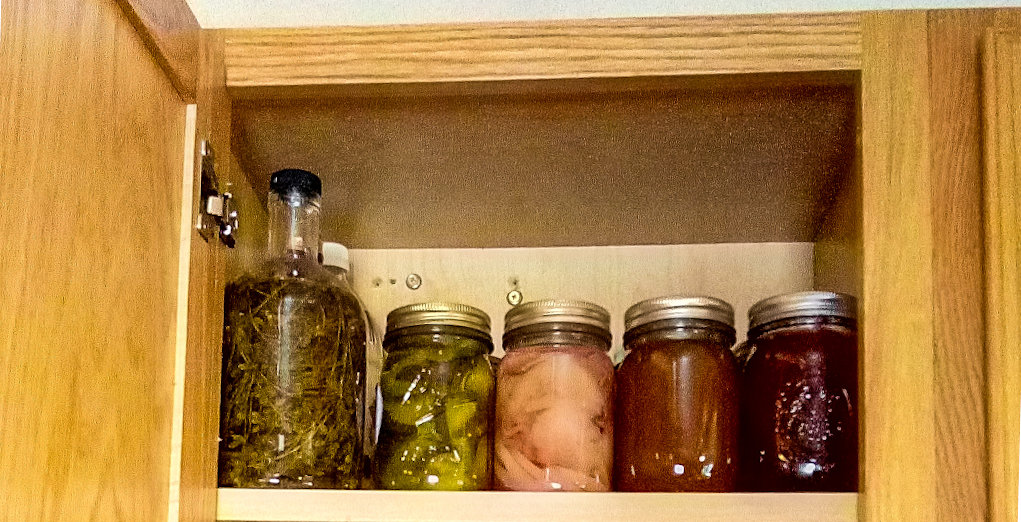
Canned goods in a pioneer pantry
Some of last summer’s produce: lemon thyme vinegar, bread & butter pickles, pickled beets & onions, rhubarb orange spread, and strawberry jam.

Preserves

  • Jams and jellies
  • Fruit or flower syrups
  • Pickles
  • Salsa
  • Mincemeat

Miscellaneous

  • Coffee
  • Tea
  • Vinegar: white, red wine, apple cider
  • Worcestershire sauce
  • Soy sauce
  • Dried tomatoes for sauces
  • Dried vegetables for soup
  • Vegetable soup base
  • Pasta
  • Granola and/or cereal
  • Granola bars
  • Crackers or pretzels

My list of pantry essentials is mostly ingredients, as you can see. However, I’ve included a few prepared foods in these lists, because I do stock them.

Sometimes those are homemade, and other times they’re from the store. I try to make most of our food, but it’s not 100% from scratch.

Stock up and Save

One of the perks of having a pantry is that keeping a supply of staples allows you to shop around and find the best prices instead of paying whatever the grocery store asks when you run out of something.

(To keep this cushion, make sure you put an item on your shopping list BEFORE it’s all gone!)

There are a few different ways to find the best prices while stocking up on pantry staples. You can use these methods now as you learn how to stock a pantry, and in the future to keep it well stocked.

Wait for sales

Flour and dried beans may never go on sale at your local grocery store, but that doesn’t mean you can’t take advantage of sales when stocking your pantry.

The best way to use sales to buy multiples of an item when it’s on sale, so you don’t have to buy it when it’s not on sale. This method does require some forethought and planning.

For example, I check the price on peanut butter frequently, even when I don’t need it. That way, I always catch the sales, and never have to buy it when it’s not on sale.

It may take a while to learn which items go on sale in your local stores, and your shopping trips might be a few minutes longer when you’re checking prices, but the savings are worth it!

Wholesale or Co-op

Local co-ops can be a great way to buy in bulk and save money on shipping costs, particularly for large or heavy items.

The basic idea is that several people order together from a company, so they can get a wholesale price and/or a discounted shipping rate.

Some co-ops get shipments only once every few months, while others have their own local stores where members can purchase goods any time.

Some co-ops charge a membership fee, so don’t forget to factor that into the cost of the goods.

Ask your friends or neighbors if there are any co-ops in your area.

Shop with a friend

Even if there aren’t any local co-ops (or they just don’t carry the items you need), you can apply that principle on a smaller scale if you shop with a friend or two.

Our local grocery stores don’t have the best (or freshest) selection of bulk spices. I often split an order of bulk spices from an online supplier with my mother and sister. We split the shipping costs, and sometimes split large packages of herbs and spices.

Do you dream of having a homestead-worthy supply of food to last you through the winter (or just in case)? You can! Even if you don't have a farm or a garden, this guide shows you how to stock your own pantry.

Pantry Food Storage Tips

Learning how to stock a pantry is just the first step. Make sure you also follow these tips to ensure that your food stays consumable!

If you’re wondering about the shelf life of certain items, or how to store them properly, check out this guide to shelf life basics.

Rotate your supply

Use the oldest jars and cans first. You don’t want any food in your pantry to spoil, especially if you’ve taken the trouble to can and preserve it.

An easy way to prevent spoilage is to put the new batch of, say, strawberry jam, behind the older jars.

Of course, you should also label each jar with the date so there is no question of how old it is.

Make sure your pantry foods are safe from pests

Grains and flour are best stored in bins or buckets with tight-fitting lids. Consider transferring pasta from cardboard boxes into glass jars with screw-on lids. You can do the same for beans and rice.

If you would rather keep the food in its original packaging, then store the boxes or bags in a larger tub or bucket, with a tight lid to keep critters out.

Also, keep your pantry clean and tidy. If you spill oats or flour on the floor, sweep up the mess right away so it doesn’t attract bugs.

This guide to stocking a pantry plus FREE printable shopping list will help you prep like a pioneer!

Ready, Set, Go!

Now you know the basics of how to stock a pantry! Ma Ingalls would be proud. Even if it’s not filled with home-canned pickles and jellies right away, it’s still a big step in the right direction.

Remember that pantries are constantly changing, and sometimes there will be more food than others. That’s okay.

FREE Printable Pantry Staples shopping list!

Don’t forget your free printable shopping list! Bring it with you to the grocery store or the co-op, so you have a guide to stocking your pantry. Then post it in your pantry, so you can keep track of your supplies.

If you would like to read more about how to stock a pantry while saving money at the grocery store, check out Ultra Power Saving Mode for your Grocery Budget.

Now that your pantry is fully stocked, check out these simple recipes from pantry staples!