Posted on 4 Comments

Why You Should Have A Simple Meal Plan

simple meal plan
simple meal plan
Are you stressed from spending too much time in the kitchen? Here’s why you should make simple cooking a habit, with some wiggle room for creativity!
why you need a simple meal plan

It’s so easy these days to get caught by the lure of fancy cooking. Making meals takes up a fair amount of time each day, and most of us like to keep it interesting. However, there are some good reasons to stick to a simple meal plan, despite the temptation to experiment with elaborate recipes.

The Lure of Gourmet Cooking

There are days (or weeks) when menu planning seems to require too much energy, and then you can end up eating the same dishes week after week. Most of the time, I crave more variety and creativity in cooking–and that’s where the problem starts.

Social media is full of glossy photos of mouth-watering meals. Cookbooks have high-quality, full page pictures displayed alongside the recipes. Of course there’s nothing wrong with that. It’s good advertising, and I am very susceptible to it!

Exotic cuisines generally aren’t my style, and I don’t often try them. But elaborate recipes with fancy ingredients can be pretty tempting, both for the challenge of making them correctly and for the delight in serving (and eating) a fancy dish.

Reasons to Cook Simply

Now, there are several reasons why this is not the best cooking habit. First, to put it plainly, our grocery budget doesn’t accommodate a lot of fancy ingredients. Pantry staples and fresh, whole foods? Yes. But specialty condiments or expensive brands? You won’t find those in my kitchen.

Also, who wants to run to the grocery store every other day because you wanted to make a meal that requires ingredients you don’t usually stock? Not me!

The other negative effects aren’t quite as easy to see at first glance–but they are just as important. These other costs are time and peace of mind. They go hand in hand, because the more time I spend cooking unfamiliar or elaborate recipes, the more stressed I get.

This can be magnified when you’re cooking for a special occasion or a large group of people. The costs of time and mental energy can really add up to make you exhausted and sick of cooking.

Lessons Learned

A few weeks ago, I had found a recipe that looked exciting, and I really wanted to try it. I only had to buy one “special” ingredient, and that’s only because my cilantro died. So it wasn’t a pricey meal, but I could tell it would be labor-intensive.

Add to that the fact that it happened to be my worst day of a nasty cold, and then someone decided it was a good day to clean the house from top to bottom…

Cooking and cleaning all day with a cold made me grumpy (have you tried chopping onions when your eyes are already watery?), and by suppertime, I just wanted to go to bed.

The meal wasn’t anything to write home about, either. I was hoping that it would be amazing and we would end the day on a high note, but instead it just left me wondering why I spent all that time and effort on it.

I could have had a much more peaceful and enjoyable day if I hadn’t tried to cook such an elaborate meal.

So what’s the solution? Never cook fancy meals? Stick to rice and beans for the rest of your life? I don’t think so. Rather, I try to set a simple meal plan and stick to it most of the time, while allowing room for more elaborate meals on special occasions. It’s part of living an organized and simple life.

simple meal plan

How A Simple Meal Plan Can Decrease Stress

But doesn’t meal planning take lots of time and complicate your life? you may wonder. It doesn’t have to.

Now, if you sit down with ten cookbooks and a few Pinterest boards full of recipes, then try to choose a week’s worth of meals from that huge selection, it’s going to be overwhelming. It can take hours and leave you feeling frustrated.

I know because that’s one of the methods I tried when I was learning how to plan meals.

But if you go about it with a more reasonable strategy, meal planning can save a lot of time you would have spent staring into the fridge wondering what to cook for dinner.

When you have your meals planned in advance, you don’t have the daily stress of coming up with a meal and hoping you have all the ingredients.

You can just glance at your meal plan in the morning to see if there’s anything to make ahead. If not, you don’t even have to think about dinner until it’s time to start cooking!

This gets cooking out of your head, eliminating stress and giving you time to think about other things.

What is a Simple Meal Plan?

It doesn’t mean you have to eat the same meals over and over again, or only eat desserts on holidays. Not at all. The beauty of a simple meal plan is that you can intentionally schedule a variety of simple recipes so you’re not always stuck making the same four or five meals!

By simple meals, I mean those which you can prepare from ingredients you normally keep on hand, and which don’t involve many different dishes.

Typically for us, this would be a casserole, soup, or one pot meal, along with a vegetable and/or bread. There’s a lot of room for creativity within that framework, so I don’t feel cramped.

Remember that the individual dishes should also be fairly simple- at least as a whole. If each part of the meal takes you two hours to prepare, I wouldn’t call that a simple meal.

When I say that, I’m talking about hands-on cooking time. Of course baking bread or roasting a chicken takes hours, but most of that time you aren’t actually working on it.

Slow food is fine. (It’s ideal in my book!) Elaborate cooking isn’t bad, but for the sake of simplicity, it’s best saved for special occasions.

Meals to Mark the Days

If you eat exotic or fancy meals all the time, how do you mark the meaningful days of the year? Growing up in a tradition of fasting and feasting at different times during the year, I have always seen food as an important way to commemorate holidays, birthdays, and other special occasions.

Preparing special meals on these days is a simple way to make them special, and it doesn’t involve storing bulky decorations or spending a lot of money.

But again, it only seems special in contrast to simpler meals on ordinary days. So my goal in creating a simple meal plan is really to plan special meals on special days, and serve simpler fare the rest of the time.

And when I talk about saving special meals for special days, those come fairly often in our house. Of course big holidays like Christmas and Easter deserve elaborate meals. On birthdays, we let the birthday boy or girl choose the meal, and celebrate with cake and ice cream.

But we also celebrate special feast days in the liturgical calendar: both solemnities (the highest ranking feast), and those saints’ days that have a particular significance to us.

Now, I don’t make huge meals on these days, but they are a good excuse to make dessert or have some food associated with the saint, like Irish food on St. Patrick’s day.

Flexibility is Key

A simple meal plan is a great tool for streamlining your cooking–if you use it that way. On the other hand, if you create a meal plan and then think you absolutely need to stick to the plan, it could end up complicating your life.

Remember my cooking fail example above? The more reasonable option would have been to cut myself some slack that day both for being sick and for deep cleaning the house. I should have substituted an easy meal for the complicated one I had planned.

Keep this in mind when building your simple meal plan. If you plan a week’s or even a month’s worth of meals at a time, remember it’s completely acceptable to adjust the plan as you go.

If a special day comes up and you just don’t have the time or energy to make an elaborate meal, don’t beat yourself up over it. There are much more important things in life!

Balancing Simple with Special

One of my favorite parts about having a simple meal plan is that special days no longer come up unexpectedly and leave me scrambling for a last-minute dessert. I now plan ahead for birthdays and holidays, so I’m sure to have all the ingredients I need.

In my ideal world, the everyday fare in our simple meal plan would be punctuated by bigger Sunday dinners and a few saints’ days each month, plus birthdays and big holidays with their own special meals.

I’m not quite organized enough to do all of this yet, but it’s getting there. And I’m okay with celebrating random days once in a while because I found a recipe I just had to try!

Free meal planning resources!

To learn how to set up your first meal plan, read this article on Easing into Meal Planning.

For more on simple living, check out these articles on living in a small space and simplifying road trips with a toddler.

Posted on Leave a comment

How to Dry Tomatoes in the Oven

oven dried tomatoes
dried tomatoes
Drying tomatoes in the oven is an easy way to preserve tomatoes when you don’t have enough to can or if you have smaller varieties like grape, cherry, or plum tomatoes.

Are you looking for more ways to use your tomato harvest? Love the flavor of sun-dried tomatoes, but not the price? It’s super easy to make dried tomatoes at home, without any fancy equipment! Read on to learn how to dry them using your oven.

This year, we grew some wonderful golden cherry tomatoes. I love cherry tomatoes, and these were deliciously sweet and juicy. The yield turned out to be larger than I had planned on, and we were getting several cups of tomatoes per week for a while.

What can you do with so many little tomatoes? Salads are great, but you can only use so many that way. I wanted to preserve them somehow, but I thought it would be a waste of time to boil and skin them all for tomato sauce.

Then I stumbled across a recipe that called for sun-dried tomatoes, and that got me thinking about other ways to dry tomatoes. (No way is the sun going to dry my tomatoes in Alaska in September.)

Why make dried tomatoes?

Drying them is a great way to preserve smaller tomatoes like cherry or plum varieties. You don’t have to worry about skins with this method, and the cherry tomatoes need only be cut in half before drying.

The end product is also versatile. You can crush dried tomatoes into a fine powder to add to soups or sauces, rehydrate them and use like canned tomatoes, or just add them to recipes the their dried state for concentrated tomato flavor.

I also like to eat them plain as a snack. Just a bit sweet and full of tomato-ey goodness, they’re kind of like a savory raisin. I believe my toddler thinks they are raisins, in fact.

It’s kind of surprising how much flavor is packed into these little tidbits. You bite into one, and your mouth is suddenly filled with tomato. I don’t think raisins or dried cranberries have quite the same effect.

At any rate, drying tomatoes is a great way to preserve tomatoes if you don’t have a large enough quantity to can, or the fruits are too small to make that method worth the work!

Method

If you live in a hot, dry climate, by all means try sun-drying your tomatoes! And if you have a dehydrator, that method also works well. (For a good dehydrator tutorial, try this one from Grow A Good Life.) But if you find yourself without either of those options, here’s how to dry your tomatoes in the oven.

tomatoes in colander
First, rinse your tomatoes in a colander and remove the stems.

First, wash your tomatoes and remove the stems. I like to use a colander so they can drip dry while I’m doing something else. They don’t need to be completely dry when you put them in the oven, but it’s a good idea to roll them on a towel or let them dry in a colander for a while. You don’t need extra moisture in the oven; after all, it’s supposed to be a sauna, not a steam bath!

Prepare your equipment

Set out some large flat baking pans. If they are made of aluminum, I recommend lining them with parchment paper. Tomatoes can react with aluminum.

I also recommend using pans with sides, not cookie sheets that are flat on three sides. The tomatoes tend to move around a bit–at least when I’m taking them out of the oven!

Set your oven to the lowest temperature setting. Hopefully this is below 200 degrees Fahrenheit. If 200 is the lowest temperature your oven allows you to set, see if there is a “warm” setting and use that.

The goal is to use enough heat to evaporate the water in the tomatoes, but not so much heat that they cook. I have had pretty good success with an oven temperature of 170 degrees, which is the lowest my oven goes.

Prepare the tomatoes

Now that your tomatoes have been sitting for a few minutes, they should be fairly dry and ready to go. If you’re working with cherry tomatoes, slice them in half and lay them, cut side up, on the baking sheets.

If you are using plum tomatoes or anything larger than cherries, you will need to slice them more than once. The thinner the slices, the faster they will dry in the oven; however, you don’t want them falling apart.

Use your judgment and find what works for you, but I would definitely recommend slicing them less than 1/2-inch thick. Otherwise, you will be waiting a long time!

You can put the tomatoes pretty close together on the baking sheets. They are going to shrink, not expand! (You might be surprised at how much they do shrink! This is a very effective way to preserve tomatoes if you don’t have a lot of storage space.)

Drying the tomatoes

When the sheets are ready, place them in the oven. Then walk away for an hour. I check on my tomatoes about once every hour during the drying process.

First, you will see the cut tops of the tomatoes start to dry out. When they are no longer sticky to the touch, after a couple hours of drying (based on my oven temperature of 170 degrees; your times may be different with a different temperature), the tomato slices are ready to be flipped over.

Turning them over allows for more even drying. I turned the cherry tomatoes over 2 or 3 times during the drying process, but larger tomato slices or a different oven temperature may affect the drying time.

When are they done?

After a few hours, the tomato slices will begin to look like raisins. To check to see if they are done, cut into a slice and see if there is any moisture left inside.

Alternatively, try to squish or bend the tomatoes. I dry mine to the point where they feel like old raisins–the ones you don’t really want to eat because they’re hard. They don’t snap when you bend them, but they definitely aren’t squishy.

Note: if you want to make tomato powder, be sure to dry the tomatoes until there is no moisture left inside of them.

You will need to keep checking on the tomatoes throughout the drying process. If the tomatoes were different sizes, the smaller ones will dry faster. They should be removed from the pans when they’re dry, so they don’t burn while you’re waiting for the larger pieces to dry completely.

The actual drying time will vary based on the size of your tomatoes and your oven temperature. My first batch took roughly 4-5 hours, but I did stop in the middle of that and let them sit overnight before finishing the drying process in the morning.

Storage and uses for dried tomatoes

Dried tomatoes in oil
If you store dried tomatoes at room temperature, use small airtight jars.

You can store the dried tomatoes in freezer bags in the freezer, or in a jar with a tight-fitting lid. If you choose this method, use jars that hold about as many tomatoes as you will use at a time.

You don’t want to open and close the jars many times in a humid climate, as moisture in the jar can cause the tomatoes to mold. Packing them in oil solves this problem.

Dried tomatoes can be chopped and added to soups, stews, or sauces, where they will rehydrate in the liquid. Alternatively, you can rehydrate them in boiling water. Just cook them until they are soft and no longer chewy. This can take 20-30 minutes.

To make tomato powder, simply whirl your crisply dried tomatoes in a food processor. You can store this in jars at room temperature and use like a dry form of tomato paste. It’s surprisingly versatile!

That’s really all there is to it. Drying tomatoes is pretty simple, even if you don’t have hot summer sun or a dehydrator. It’s a great way to preserve your garden produce, so you can keep enjoying it all winter long!

For more tips on using your harvest, check out this article on cooking carrots.

Posted on 4 Comments

Cultivating Hospitality

hospitality

Part 1: The Last of the Homely Houses

hospitality

It was a night of thick darkness. The wind pushed at my car first from one side, then another. The rain spattered against the glass violently, and my headlights seemed futile against the outer blackness. Even the familiar roads seemed to stretch beyond their normal length, as a shadow stretches past its object. And then, all of a sudden, lighted windows flashed out like the beacon of a lighthouse. They seemed to spill laughter and cheer, as if the house could not contain its mirth. As I approached, I could not help thinking that this must be the “last homely house” described by Tolkien.

A Light in the Darkness

A homely house is the image of hospitality. An open door and a hearty welcome are among the most valuable things one can offer to his fellow man. To the weary traveler, it promises safety, comfort, and rest. To the starving, it promises sustenance. To the lonely, it promises companionship. To the confused, it promises assurance. To the anxious, it promises peace.

These homely houses are like islands in the midst of a stormy sea. So many houses stand dark and empty, while their inhabitants seek pleasure and entertainment elsewhere. People spend fortunes on extravagant homes, yet hardly live in them. Nobody is at home to welcome the stranger or traveler. And aren’t we all travelers, storm-tossed by the world at one point or another? Don’t we seek refuge from anxiety, confusion, or desolation? Are we not all in need of some bright and happy resting place to rejuvenate our spirits before plunging again into our daily battles?

The Personal Factor

But perhaps hospitality is outdated. Maybe it had a place in the ancient world or the Middle Ages, but surely modern peoples have moved beyond that with their huge technological advancements? We have found new ways of connecting with other people, even those who live on the other side of the globe or speak a different language. Contemporary society highlights social media and the myriad ways we can interact with others.

All the social media in the world can’t replace hospitality. The world can be a very cold place, and all of its technological “connectedness” can leave us feeling more isolated than ever. Interactions through text on a screen prevent one from experiencing another as a person. When we remove the humanity–the personal factor–from a situation, that reduces it to one of utility only. What could have been a congenial conversation turns into an interaction where the other person’s worth is based on whether or not he can answer my question or benefit me in some way.

Compromising Human Dignity

This attitude of basing a person’s worth on performance or productivity can easily become a habit. This affects our interactions and relationships with people we do see face to face–or “in person.” This phrase is key because it shows that when we are physically present with another human being, we experience his or her personhood. This is more than his speech, voice, and physical appearance: a robot has those. It’s his entire being, composed of body, mind, and spirit. This being calls for a response worthy of a human person.

A response of utility does not acknowledge the dignity of a person. However, when all we see is a line of text on a screen, it’s easy to forget that there is an unrepeatable human being at the other end. All this to say that we as persons desire and need to be treated with a dignity and kindness, and hospitality does just that. This is why hospitality is so important, today and in every age: it is a distinctly human trait which nourishes body, mind, and spirit.

hospitality

The Elements of Hospitality

Physical Elements

Hospitality’s first aim is to provide for the material needs of the body: food, clothing, and shelter. Whether it’s an elaborate feast or a simple repast is not the point. The point is sharing food with someone who’s hungry. Just like any other virtue, hospitality focuses outward, on other people. It isn’t turned inward toward itself. Hospitality sees a need and does what it can to help, like the Good Samaritan. He showed hospitality to a stranger even while he himself was traveling, and had to go out of his way to provide for the needs of the injured victim.

Thus hospitality isn’t something you can only practice at home. But it does start at home. Hospitality is about taking care of people and providing for their needs–and what better place to do that than in your own home? Within a family, there are countless opportunities for feeding the hungry, giving drink to the thirsty, comforting the sorrowful, and attending to a host of other material, mental, and spiritual needs. Indeed, family life is like a school for learning mercy and putting it into action.

Intangible Elements

Besides providing for the physical needs of the guest, hospitality attends to his mental and spiritual needs as well. The most important of these are the gifts of rest and refuge. There is a hospitality of the heart which extends beyond a physical offering of food and drink: it invites him to participate in the life of the home he has entered, to be a part of the family for a time.

This doesn’t mean that each guest learns everything there is to know about his host, or vice versa. In fact, respecting privacy is an important part of hospitality. But welcoming a guest to participate in family life means accepting him as he is. This acceptance is what produces a psychological place of rest, a safe haven where one can relax his constant vigilance.

Hospitality in Middle Earth

In The Fellowship of the Ring, Tolkien describes Rivendell through Bilbo’s eyes. He says it is “a perfect house, whether you like food or sleep or story-telling or singing, or just sitting and thinking best, or a pleasant mixture of them all. Merely to be there was a cure for weariness, fear, and sadness.”

What makes Rivendell such a perfectly balanced environment? How can one house suit every temperament? Hospitality draws the guest in, but also gives him space to himself. The thoughtful host may offer an array of activities, but not insist that the guest participate in all of them.

Offer the Best

Let’s look a little deeper at what Rivendell offers to guests. The first thing Bilbo mentions is food. This is not surprising, as he is a hobbit. It’s pretty important to us humans as well. But it’s not just any food: “More than a meal! A feast!” Merry tells Frodo jubilantly. “As soon as Gandalf reported that you were recovered, the preparations began.” Elrond gives his guests the best he can offer. Of course, not everyone has the means to feast their guests. We see the same hospitality in The Hobbit when, years earlier, Bilbo entertained an unexpected party of dwarves. His food was not fancy, but he gave the best he had.

Sleep is the next item on Bilbo’s list. It would be easy to say that everyone needs sleep, and leave it at that. There’s more to it, however. Frodo’s injury and subsequent recovery in Rivendell highlight the importance of sleep for healing and rejuvenating both body and spirit. This restorative sleep is not possible unless one is in a safe place, so sleep and safety are closely connected.

Revitalizing Leisure

Story-telling and singing probably aren’t the first things that come to mind when we think of hospitality. But again, hospitality is about more than food and shelter. In The Lost Arts of Modern Civilization, Mitchell Kalpakgian speaks of the “revitalizing leisure of hospitality” which “cheers the heart, uplifts the soul, exhilarates the body, and elevates the mind.” (p. 4) Leisure activities such as singing, dancing, good conversation, story-telling, sports, and games are very much a part of hospitality.

The final item Bilbo mentions in his description of Rivendell’s hospitality is “just sitting and thinking.” Any host might wish to entertain his guests and enjoy their company, but it takes humility to step back and allow the guest time alone.

A hospitable household will never lack friendship. And true friendship is a gift that technology cannot give. If families are the building blocks of society, then hospitality is the mortar that glues them together. It unites people in their common need for food and shelter, as well as companionship. Welcoming another person enriches both the host and the guest, and makes their lives a little brighter.

***

If you enjoyed this article, continue reading Part 2 of the Cultivating Hospitality series.

Posted on Leave a comment

Hearty English Muffins

Hearty English Muffins
English muffins are a simple, versatile bread that can be made into toast, sandwiches, or even mini pizzas.
Jump to Recipe

Toast is a breakfast staple around here, and English muffins are one of my favorite kinds of bread to toast. They come in individual servings, they don’t tend to get crumbs everywhere like a big loaf, and their texture when toasted is just right: not too dry, nor too chewy. Then there’s the added bonus of complementing just about any topping you could come up with. From butter, nut butters, jam, or honey to bacon and eggs or pizza toppings, English muffins are surprisingly versatile.

Recently, most of my English muffins have been made with sourdough, but today I wanted something fluffier and heartier. I know those two words don’t seem to go together, but compared to the sourdough muffins, these have much more of a rise, so there’s just more to them. They are quite delicious fresh from the skillet to the toaster, but don’t burn your mouth!

Making the dough

English muffin dough behaves like any yeast bread dough. Dissolve the yeast in the “wet” ingredients, then stir in the flour and salt. I like to add about 4 cups of flour at first, then the rest 1/2 cup at a time. When the dough gets too stiff to stir, turn it out onto a floured counter or board. Knead it thoroughly, adding flour as needed, until the ball of dough is smooth and elastic. You want a fairly stiff consistency, so the muffins won’t fall and lose their rise when you transfer them to the skillet.

rolling dough
Roll out the dough to about 1/2 inch thick. The muffins should double their height by the time they’re done cooking.

Let the dough rest for 5 minutes, then sprinkle some cornmeal onto the counter and roll it out 1/2 inch thick. Don’t worry about making a perfect rectangle; you will be cutting it up anyway. You can make the muffins whatever size you want. If a biscuit cutter seems too small, try using an upside-down glass or small bowl to cut the dough. While the muffins will double their height, they won’t get much bigger in diameter. Combine any remaining scraps of dough and form them into another muffin or two. They don’t all have to be the same size.

 English muffins on baking sheet
Let the muffins rise on cornmeal-covered sheets for 35-40 minutes.

Once you have the muffins cut out, place them on cornmeal-covered baking sheets to rise. You don’t need to grease the sheets. The muffins only need 35-40 minutes to rise, but a bit longer isn’t a problem.

Skillet Tips

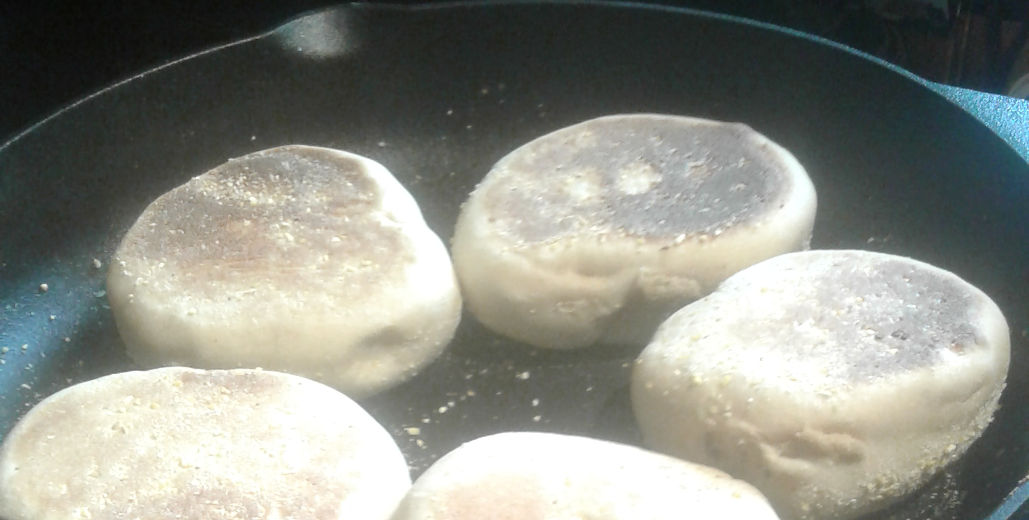
When the muffins have risen, heat a large, heavy skillet over medium-low heat. Cast iron works best. Place muffins in the skillet, making sure both sides are coated with cornmeal. Don’t overcrowd the skillet, but it’s not a problem if the muffins are touching just a little.

Don’t crowd the muffins in the skillet. It’s fine if the edges barely touch.

If you’ve never cooked anything on a dry skillet, you may have to play around with the temperature, so keep checking your muffins while they cook. I cook mine somewhere between low and medium low, depending on how fast they are cooking–and my level of patience!

Flip the muffins over carefully after the first side has cooked. Don’t squish them down in the pan–you don’t want to lose the rise! It’s best to use a heat-proof spatula to avoid burnt fingers.

In an ideal world, every muffin will get cooked to a nice golden brown on each side, without any gooiness in the center. In my world, either the edges cook too fast and the center gets underdone, or one side ends up much darker than the other, or there’s a diaper explosion and I come back to a smoking skillet…

English muffins
English muffins should be cooked until golden brown on both sides and cooked through the middle.

If the center does seem a bit underdone, you have a few options for recovery. First, you can try putting the muffins back in the pan on low heat. This is only a good option if the edges aren’t already pretty dark.

Second, you can bake the muffins in a 350 degree oven for 5-10 minutes. Check on them frequently, especially if they were still hot when you put them in the oven.

Third, if the center is only a little underdone, I usually end up just storing the muffins in the refrigerator and toasting them thoroughly when they come out.

Storing English Muffins

You can store your English muffins in an airtight bag at room temperature for about a week. Cool the muffins completely before putting them in a plastic bag. Alternatively, you may store them in the refrigerator. They also freeze very well, and you can toast them straight from the freezer. Breakfast doesn’t get any more convenient than that!

Hearty English Muffins

Thick and fluffy, these are not your typical grocery store muffins. With superior flavor and hearty texture, these will be a welcome addition to your breakfast table.
Prep Time15 minutes
Cook Time40 minutes
Resting Time45 minutes
Total Time1 hour 40 minutes
Course: Breakfast
Keyword: Bread, Muffins
Servings: 12 muffins

Ingredients

  • 1 cup warm water
  • 2 1/4 tsp active dry yeast
  • 2 tbsp honey
  • 1 cup milk
  • 3 tbsp butter softened
  • 1 1/2 tsp salt
  • 2 1/2 cups whole wheat flour
  • 3-3 1/2 cups unbleached flour
  • cornmeal

Instructions

  • In a large bowl, dissolve yeast in warm water. Add honey, butter, and milk. Stir in salt.
  • Stir in whole wheat flour and 1 1/2 cups unbleached flour. Add more flour 1/2 cup at a time until dough is too stiff to stir.
  • Turn dough out onto a floured board and knead for 6-8 minutes, adding more flour as necessary to prevent sticking.
  • Let dough rest for 5 minutes.
  • Sprinkle board with cornmeal. Roll dough out to 1/2 inch thickness.
  • Cut into rounds and place on cornmeal-covered sheets. Let rise 35-40 minutes.
  • Heat a skillet and cook muffins over low to medium-low heat until golden brown on each side and cooked through the center (6-10 minutes per side).
  • Cool completely on a wire rack before storing.

Notes

Cooking times are approximate and will be affected by the heat of the skillet as well as the size and thickness of the muffins.

For more baking fun, check out this recipe for pumpkin snickerdoodles!